
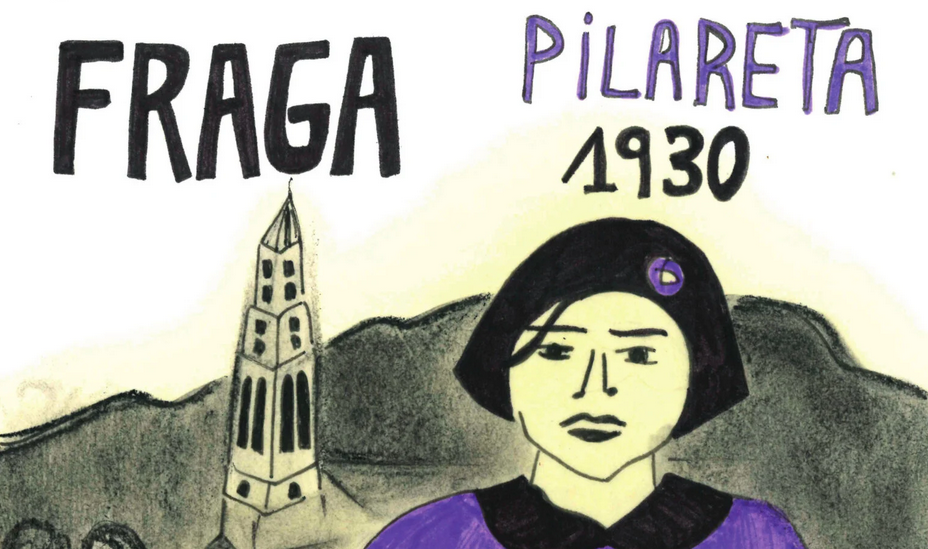
What do we know about our family’s history? How did they experience the War of 1936? And the fascist coup d’état? Did they take part on the front lines? Do we have any relatives who were exiled or disappeared? And our grandmothers, how did they experience it? What did it mean to be a woman and live through the Republic and then Francoism? How did it shape them? What have they told us? And above all, what have they not told us?
Perhaps these are questions many of us still haven’t asked our families. And if we have asked, we’ve received confused answers, long silences, a trembling voice…
During the war, 600,000 people were killed, of whom 150,000 are still missing. During Francoism, 30,000 girls were stolen from their mothers and handed over to families sympathetic to the regime. The war, the postwar period, the dictatorship, exile, the killings, the humiliations, the threats, the torture, the imprisonment — all of this generated a collective trauma in our society. Many studies show that, faced with this scenario of terror and violence, many women avoided telling their daughters and granddaughters in order to spare them pain; and also because of an inability to explain what they had lived through, and out of fear of reprisals. It’s worth remembering that the Francoist regime itself forbade it, just as it forbade any dissidence (speaking Catalan, wanting to be a different kind of woman, questioning the regime, etc.). According to Valverde1, this narrative has been passed down generationally, even though trans-generational psycho-emotional trauma also affects the descendants of the victors, not only of the defeated. And as Orwell said, “Who controls the present controls the past, and who controls the past will control the future.”
In this way, the impact of the silences, the losses, and the organised, systematic violence against those who believed in social justice and in a freer society still strikes at our present reality. In the Catalan Countries, the coup d’état and the triumph of Francoism over the legitimate Republic played out unevenly. Mallorca was one of the first places in the entire country to fall into the hands of fascism, while Catalonia and the Valencian Country resisted until 1939. The territories of La Franja and the Ebro Lands lived through a genuine massacre in the dispute over the Aragon Front. This was not a war between brothers — it was a class war, one that still endures today. Millions of people had to silently mourn their murdered and disappeared family members and friends, and also mourn what had been an emancipatory political project (still under construction). A mourning for a joy that never returned.
We recover our history to better understand who we are
The Conxa Pérez Group2, memory from Jineolojî, is a self-managed collective whose aim is to gather the testimony of women who lived through the Francoist period. We work within the methodology of Jineolojî, a revolutionary framework for the social sciences that treats history as an entity in the present moment — dynamic and alive — rather than as a strictly determined phenomenon.
Jineolojî, a frame of reference and a proposal for the future
Jineolojî is a proposal of the Kurdistan Women’s Movement. Jin in Kurmancî means “woman” and shares a root with jiyan (life). Lojî, meanwhile, refers to the Greek word logos. It is, therefore, the science of women, or the science of life. Jineolojî offers a critique of Western social sciences, which it sees as overly influenced by capitalism, colonialism, and androcentrism. It aims to be a propositional science, in service of the people and of life, not in service of capital. It took its first steps in 2012, but its roots go back to the struggle of Kurdish women militants in prison in the 1980s, and to the guerrilla resistance in the mountains against the Turkish State.
Faced with the need to overthrow Turkish fascism, and understanding that this is merely one of the many forms through which capitalism buries freedom and enslaves working women throughout the world, the compañeras considered it essential to define a new ideology, and with it, to also break with hegemonic social sciences. A tool to free themselves from colonialism and capitalism. Understanding that without the liberation of women we are condemned to repeat history, they began to forge the path toward de-patriarchalizing society and its history.
Today, all the civil, political, and self-governing institutions of the Kurdish Freedom Movement have their own women’s structures. These initiatives manage to break with the reproduction of patriarchal dynamics and oppression. Jineolojî is part of this radical transformation and is taught in the schools of the Autonomous Administration of North and East Syria (AANES). There are also numerous Jineolojî research centers, such as the Andrea Wolf Institute in Rojava, in which internationalist women participate, and Jineolojî committees around the world. From Jineolojî’s studies and analyses come proposals aimed at meeting the needs of the people. One example of this is Jinwar3, a village for women survivors of war or of situations of abuse or mistreatment³.
Thus, the Jineolojî Committee of the PPCC (Catalan Countries) is part of the Jineolojî network in Europe, from which different study and research groups are organized on topics such as resistance, mythology, health, or history. For Jineolojî, we have a duty to rethink our past and bring into the present those democratic vestiges that show us mutual aid, respect for nature, and coexistence among peoples have always been (and will always be) within us.
Jineolojî’s perspective treats history as a revolutionary memory tool, showing how values, cultures of resistance, languages, ethics, cults, stories, and much more are reflected in the present day. That is, it is about assembling a compilation of democratic and revolutionary memory and observing and organizing it according to the values defined by society, thereby establishing a strong connection between the past and present life of society and nature. At the same time, it seeks to break with patriarchal history, which recounts the past through epic tales that are, for the most part, tales of war.
Jineolojî focuses on the women who were excluded from history, from cultures, institutions, and formal units, drawing on Öcalan’s4 interpretation: “The history of civilization is, at the same time, the defeat and disappearance of women.”
We understand historical memory as an essential part of collective identity, one that is crossed through by class struggle and the struggle of the people, and that helps us know ourselves, dignify our past, and understand it as a legacy that explains who we are.
The history of our peoples has been silenced, covered up, and distorted to the point of being almost forgotten. Fifty years after the Transition, we still have not managed to free ourselves as a society from the mentality imposed by the fascist regime. Fear and silence spread like poison into the most remote corners of our territory. This silence and this fear are undeniable in the experiences lived by women and by minorities, watched over and punished by the “morality police” and by institutions such as the Patronato de la Mujer (Board for the Protection of Women). Psychological, emotional, and physical abuse, sexual abuse, degradation, ongoing humiliation, the theft of girls, subjugation… and a long list of torture strategies that help us understand some of the dynamics still alive in the socialisation that permeates our society and our struggle for freedom today.
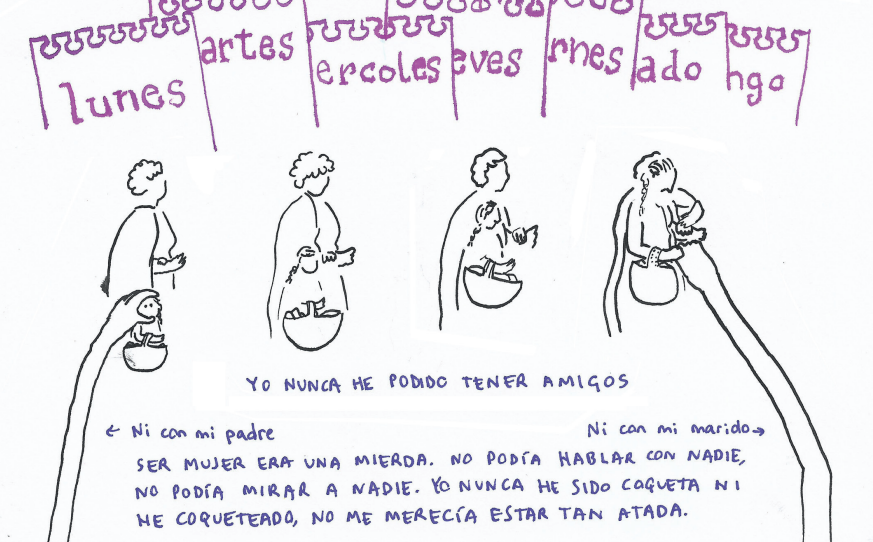
It is necessary to reclaim Historical Memory, since it belongs to the people and not to the institutions that use it for their partisan interests. Currently, at the political level, the dispute over historical memory has intensified, driven by partisan interest, without any emphasis on recovering and dignifying the history of the social revolution and of the anti-Francoist fighters, nor on critiquing the Transition. There is no political will to recover and dignify this history, nor to condemn Francoism, nor to critique the Transition. Any critical analysis has been silenced in order to continue perpetuating the same logic of domination.
Furthermore, all of this is reinforced by the way history is taught in schools, through a highly bellicose, colonial lens, seen through patriarchal eyes and reference points. We know that history also lives in everyday life, in relationships between people, in emotions, in pain, in social organisation, in the dreams and longings of the era, in women’s resistance… Jineolojî’s perspective focuses precisely on this. And that is why our first research project focused on the role that education played in sustaining the Francoist system and its silence.
Tools for historical memory: the link between generations
We have carried out a first research project, which we are sharing through the presentation of a comic (Compilation of Illustrated Oral Memory, 2024). It deals with the education of women during Francoism, both inside and outside the home, and in rural and urban settings. It is a research project built around the testimony of six women from Catalonia and La Franja. In this way, we reclaim oral history as a source of intergenerational learning: in this first research project, six illustrators lent their hand to capture the legacy and memory of these women, as a living example of collective memory.
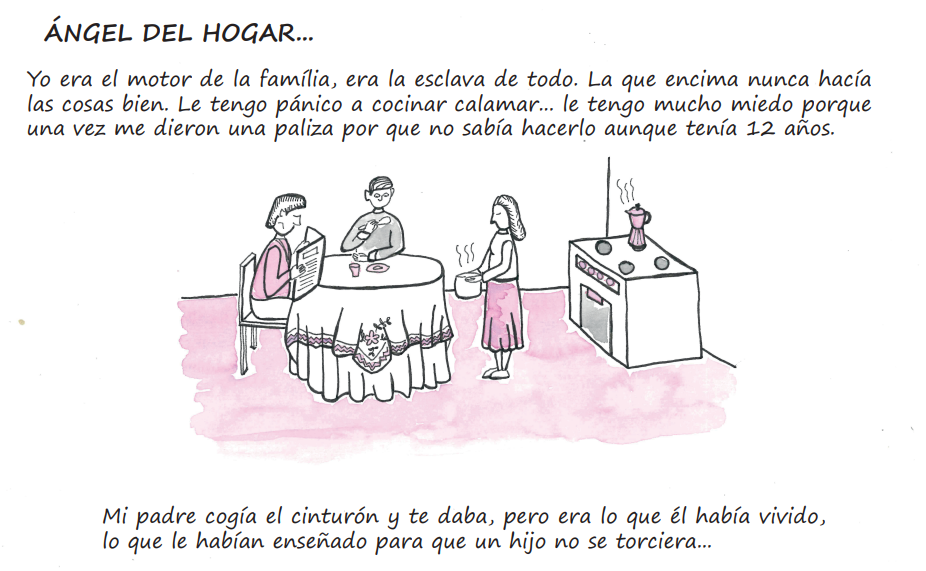
It is clear that whoever controls education controls society. That is why the saturation of Francoist ideology in education shaped the worldview of many generations. Through propaganda and the control of compulsory education, the figure of the “angel of the home” was imposed as the ideal model of woman. In this way, women were relegated to sustaining and reproducing the family, and to roles of submission, inferiority, and servitude. Education, as we understand it, frees us from dogmatism and from the system of domination, teaches us to be critical, and helps us to fully develop our personalities. The current imposed system educates us in a liberal, individualist ideology, with its sexist, colonial mindset and attitude, and so on.
While conducting the interviews for the comic book, we realised that some women were reluctant to talk about their experience, because they didn’t think it was important, nor did they understand what interest their experience could have for a “research project.” Others simply refused to speak, out of fear of repression, guilt, or having to relive it, because it is painful, and because they have learned that in order to coexist one must stay quiet, stop sharing what one lived through, feel ashamed… This has been their way of turning the page.
The main tool for identifying and ridding ourselves of the system embedded in our own personality is education. This is how we build our personality on principles of freedom. History, therefore, like education, is not foreign to us — it has passed through our peoples, our streets, our families, and that is why it is important to feel part of this memory, because it is our life, our way of seeing and understanding the world.
For the comerades of the Kurdistan Freedom Movement, perwerde (education) is the path toward developing harmony between what we feel, what we say, and what we do. This is where true beauty and revolutionary strength reside. Above all, education is a form of self-defence, because people who are educated on principles of freedom, and through the development of knowledge about their society, their history, and their identity, will not accept the imposition, domination, and colonisation of the capitalist system. Through Jineolojî, and therefore through this work, we promote self-education and the investigation of our own families, peoples, and territories, and the importance of oral transmission. We understand that, even though this process of Francoist assimilation took place years ago, it is still part of our life.
As a society, we carry an imposed void with respect to our recent history. It is up to us to fill it and to create spaces where we can speak and claim it as part of the public sphere. The past cannot remain on some nonexistent plane — it must be part of the present, in a constant, revisable dialogue. We are not a blank slate, a mere “here and now,” as Capitalist Modernity tries to make us think. Recovering memory, history, what happened, and honouring the lives that were taken from us is an essential task in order to do justice and avenge those who gave their lives. This social justice cannot be confined to one territory or to an imposed state, because it is precisely through division that states have silenced the history of thousands of peoples.
In conclusion, this comic gives body and soul to expressions of life, to the learnings and experiences of everyday life. We have crossed walls and unearthed memories in order to find the impulse of self-defence that lives in all of us, in body and soul. Resistances have emerged even from within the shadows. We invite you to learn more about our work by coming to the presentations of the comic book Compilation of Illustrated Oral Memory, which we are holding throughout the Catalan Countries.
We are also currently in the midst of a second research project. Since February 2024, we have been focusing on gathering life stories marked by repression directed at women for being read as “red,” and the resistance they put up. Women who lived a stigma because they had anarchist, communist, or republican relatives, or women who had themselves actively participated in political life and who also shared these ideological frameworks.
We continue researching the legacy of repression and resistance experienced by ordinary women — poor, rebellious, shy, brave — simply for being read as “red women.” These are harsh accounts, but also everyday forms of resistance that many of them still practice today, showing us the importance of doing this work,. The same fascist mentality is still present in a society that does not want to listen to its foremothers and that perpetuates the fear of speaking about what was lived.
In every dark night, there is clarity. Though, indeed, it must be sought beneath the rubble of history. And this is what we try to do. We know that this land has lived through revolutionary moments that changed the course of history, that set a precedent, and we know that many women and dissident identities made this possible, and that without them we would not be where we are today.
We honour their courage and their strength, in a time when raising your head was harshly punished with death. If we raise our heads today, it is because all of them raised theirs before us. They faced fascism, exile, control, censorship, prohibitions, abuses of every kind, but they never abandoned their love for life and for freedom. In their struggle we search for the truth of who we are, of where we come from. This is the path where all other paths meet: the path of the search for freedom. In memory of those who raised your voices so high that today we can still feel your song of freedom.
Long live the anti-fascist struggle, long live the resistance of women!
We continue working on our research into repression against “red women.” If you have information or know of a witness, contact us at: [email protected]
This article was originally written in Catalan.
1 Valverde, Clara. Desenterrar las palabras (2014).
2 As a mark of respect and admiration, we have chosen to name our research group after Conxa Pérez, as she is, for us, a symbol of resistance. Conxa, born in Les Corts (Barcelona) in 1915, was an activist throughout her life, starting with the CNT as a young woman before becoming involved in neighbourhood struggles. She defended freedom and fought against fascism. From the proclamation of the Republic, she began frequenting libertarian cultural centres, becoming so deeply involved that she ended up spending several months in the women’s prison. When the war broke out, she joined the revolutionary committee of Les Corts and was one of seven women who formed part of a group of one hundred armed soldiers known as the Aguiluchos de Les Corts. Among other actions, she took part in the attack on the Modelo prison to free political prisoners and in the armed struggle at the Pedralbes Barracks. In December 1938, she fled to France and stayed at the Argelers refugee camp. In 1942 she returned to Barcelona and opened a stall at the Sant Antoni Market, which became a clandestine meeting place for the anarchist movement. In the late 1990s she joined the ‘Mujeres del 36’ collective, which works to vindicate and restore the memory of women who suffered reprisals during the Civil War.
3These grassroots women’s initiatives are currently under threat and attack from jihadist militias aligned with the new Syrian Transitional Government, which is controlled by HTS (Hayat Tahrir al-Sham). The military objective of this government is to target ethnic minorities and, in particular, the revolutionary project of self-government in northern and eastern Syria – called the Autonomous Administration of North and East Syria, which emerged in 2012 against the backdrop of the Syrian war. Women are one of the groups most affected by these attacks: when the fundamentalist militias entered the self-governed territory, they did not hesitate to expel and violently attack women from their centres and academies, to close down and destroy their institutions and workers’ cooperatives, and to murder and abuse young women activists… The strong symbolic significance of women’s liberation has turned the destruction of their autonomy into a form of ideological warfare.
4Abdullah Öcalan is the founder of the Kurdistan Workers’ Party (PKK). He has been unlawfully imprisoned and held in solitary confinement on the prison island of Imrali in Turkey since 1999. Öcalan put forward the proposal for Democratic Confederalism, which inspired the 2012 revolution in Rojava (Western Kurdistan) and the political model of the Democratic Autonomous Administration of North and East Syria.