We are all YPJ! – Self-defence is our natural right
Today, the 26th April 2026, the campaign for defending the women’s defence units begins. To contribute to this, we want to share some words on how this heroic and historical units came to be built.
In the land that the YPJ are defending, existence means resistance, and therefore, celebrating today the women’s army YPJ, means defending it. The women’s revolution of Rojava stands up for the democratic integration of the autonomous women’s forces into the State structures as agreed upon the agreement of the 27th of January. The YPJ are not just defending the achievements of the women’s revolution against the attacks of fundamentalism and patriarchy, but are truly the defence for all society and life itself.
Since the YPJ was founded at the 4th of April in 2013, they have made it clear that they are a force of self defence not just for women in North and East Syria, but in the whole world. This is not merely an armed defence against a tangible enemy, but a broad and holistic expression of women’s self-defence. It demonstrates that women, wherever they may be, have the capacity and the right to defend themselves alongside their sisters, and thus to defend their land, their people, and their society.
Em hemû YPJ – We are all YPJ,
This means we join the line of women’s self defence.
We want to take you back to the beginnings of YPJ, from the first trainings of getting to know a women’s strength, the first martyrs and the struggles with their own comrades of YPG. Let’s walk this path together, getting to know the impact that these women units had on society, standing up for themselves, their land and values, and at the same time for all of us.
[Firstly published in 2025 in Castellano in the book ”Mujer Vida Libertad vol.II – En el fuego de la Revolución de las mujeres de Rojava” by Andrea Wolf Institute]
Why was YPJ founded on 4th of April, Abdullah Öcalan Birthday?
Rêber Apo influenced our mindset, our organisation, and our morale. If today we can speak of the YPJ, of knowledge, of courage, and of the martyrs, it is thanks to the influence of Rêber Apo and the martyrs. He worked tirelessly for the women of Rojava, where he remained for a long time. He held thousands of meetings with women and with society as a whole. If we hadn’t known Rêber Apo’s ideology, if we hadn’t known about the women’s struggle within the PKK, if it hadn’t had an impact on us, this wouldn’t have been possible. That’s why the YPJ announced its creation on April 4, Rêber Apo’s birthday, as a gift. Because we women met with him.
Heval Narîn Afrin:
Young women were very interested in participating in the revolution. The first YPJ academy—before we were called the YPJ—was in Afrin in 2012: the Şehîd Şilan Academy. Women came from Dêrîk, Qamişhlo, and other cities. In other regions we had mixed classes, but the autonomous women’s academy was in Afrin. We trained them, and when they finished, we sent them home, telling them that if we needed anything, we would call them. I remember once meeting a girl who came up to me and hugged me; I asked her what she did for a living, and she told me she made clothes, adding: “Heval, I’ve been to your training twice, but you’ve always sent me home.”
This made me think: “Why are we sending them home?” So the leaders gathered to discuss it. I told them, “We need to hold a training session after which we don’t send the fighters home, but they stay with us.” This comrade made me think a lot, and we realized we needed a centre, an organization, a name, a way to organize ourselves as women. With this in mind, when we held a training session, at the end we told the women that anyone who didn’t want to go home could stay with us. They could visit their families once a week. Some women said, “We’re not going home at all.” These women played a pioneering role. The others listened to them and said, “If you’re not going home, why should I go home!”
By early 2013, we had achieved a high level of women’s participation. We decided to form the first battalion in Afrin. At first, we didn’t have uniforms; the women bought military-coloured clothing. To be recognized as a military battalion, we needed a uniform look—we had to wear the same colour. The women sewed their own uniforms. About 100 of them came forward as a battalion in Afrin, and this had a huge impact. Many people wanted to report on it; many people asked, “Who are they?” Our comrades made jokes; at first, they didn’t see it as a force of resistance and war. The battalion was named Şehîd Rûken. She was the first comrade from Afrin to become a martyr in the 1980s, one of the first to join the Movement. The next battalion was in Dêrîk. This battalion was named after Dêrîk’s first martyr, Şehîd Sozdar. Then we announced the Dirbesiyê battalion, named after Şehîd Berçem, a comrade from Dirbesiyê who fell as a martyr in the early 1990s. Then in Qamişhlo, on March 8, as a gift to all the women of the world. This battalion was named after Şehîd Adalet, the first comrade from Qamişhlo to be martyred. Finally, we announced the Kobanê battalion, named after Şehîd Dicle. After announcing the creation of these five battalions, we began discussions to unite them and establish our organization, the YPJ.
On April 4, 2013, we held our first congress in Dêrîk. About 150 women from all regions attended the congress. We discussed the name and decided to call ourselves the “Women’s Defence Units,” YPJ. The male comrades made their suggestions regarding the name we had chosen. They said: “Why do you defend only women?” But we were convinced: we defend women, we defend society, we defend humanity, we defend nature, we defend life. That is why we responded to those who challenged us by saying we had a very narrow and sexist view, because when they heard “woman,” they understood it in terms of gender, but in reality a woman is life and society. That is why we wanted to create self-awareness based on the gender struggle, so that women would separate themselves from men, not only on an organizational level, but also on a mental level. In our training system, we wanted them to know themselves, to draw strength from themselves, and to have mutual respect and unity among women.
We established the YPJ command: five comrades, one in charge of each region. We began to take shape as an autonomous organization. We raised our flag in each of the centres we had in the various regions. The YPG already existed, so we had to fight to have our own flag, our own organization, and our own commanders. It wasn’t easy. We brought the YPJ command together with that of the YPG, because our goals are the same, our society is the same, and there were families where the son was in the YPG and the daughter in the YPJ, and we worked together. For example, if there was an attack, the YPJ and YPG would go to the front together. Initially, the YPG comrades showed a willingness to cooperate, but without recognizing us as an organization in our own right. When we announced our formation, that was the first struggle we waged: everything in our organization had to be autonomous—our uniforms, our flag, our name. At first, the comrades did not easily accept so many differences.
In Rojava, there was no culture of women driving cars, so at first, in our YPJ centres, we had a YPG comrade as our driver. This was a major contradiction for us. We discussed it and decided we had to learn to drive. When there was a problem at the border, we decided that one of the YPJ women would drive to take us there. At first, the YPG officials refused, saying it had nothing to do with our autonomy, but we said no, we would go in our own vehicles. When they saw us arrive with our comrade at the wheel, they were all very surprised: “Wow, their driver is good too.” We started organizing driving lessons. We said, “The driver of every battalion must be a woman.” Little by little, all our drivers were women. This had a huge impact on society. There were many people, from society and political parties, who worked against us, who didn’t want the revolution, and who opposed the creation of the YPJ. They said: “These YPJ women were kidnapped from their families.” In the meetings we held with people, we explained that “in our YPJ centres there are no fences or walls; anyone who wants to can leave whenever they want, and we have centres close to the people—we don’t take them to other regions.” This propaganda against us was useless. At first, many families came to take their daughters back. These young women stood up to their families and said: “I’m not going back with you; no one is forcing me to stay here; I’m here to defend my land; I’m here to defend women.” People didn’t accept it. Back then, there wasn’t a fierce war. Sure, we had liberated the regions, but there wasn’t a fierce war between us and the Syrian state. There were many places where, after we surrounded them, the Syrian state surrendered. In other words, there wasn’t a war like the one against ISIS or the jihadists.
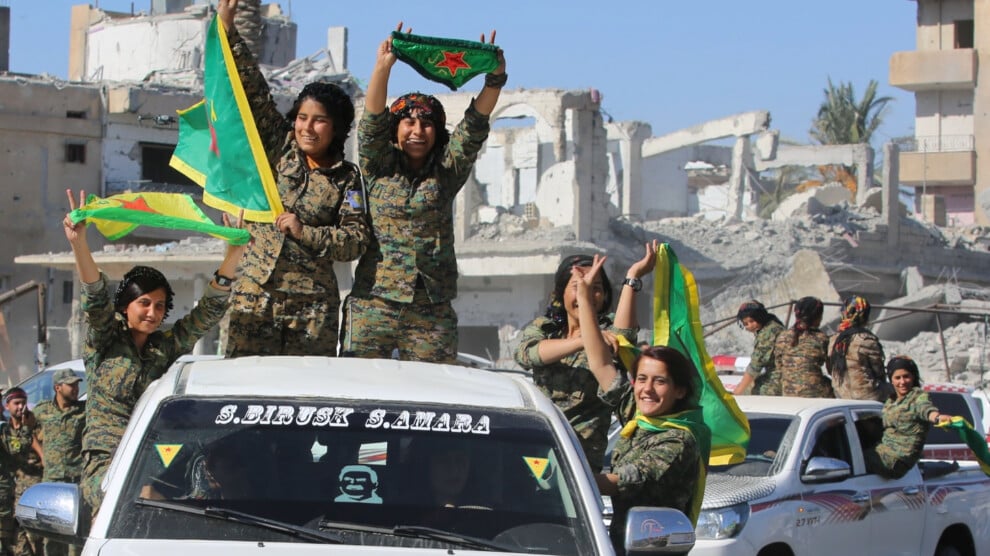
When we announced the Qamishlo Battalion on March 8, that day we participated in the demonstrations with about thirty vehicles, our weapons, and our military uniforms. That day, hundreds of women wanted to join us. Of course, they had heard that women had participated in wars in their own countries; they had heard about female guerrillas; they had seen their photos and videos—but now they were seeing this force right before their eyes. This, of course, had a huge impact. The training sessions we held within the community also had a huge impact. For example, what should be the principles of a woman joining the YPJ? What should be her attitude, her determination, her respect? I mean, no one can act within the YPJ according to individual principles, but we have concrete principles of life; if you accept them, join us. That is how we build trust within society. So it happened that many families said, “Let my daughter join the YPJ.” I remember that many YPJ members were brought in by their own parents. They would tell us, “Heval, train my daughter.” We taught them Kurdish; we taught them history. After announcing the formation of the YPJ, we made a major effort to organize our self-defence and protect our land from attacks. Little by little, the women separated from their families, left their homes and training units as their base, and became skilled in the use of weapons. There was a second attack on Afrin. Among the comrades who participated were Heval Silava and Heval Bêrîvan. Both were part of the attack group. Heval Silava was on the front lines. Heval Bêrîvan fell as a martyr in an attack, but we didn’t know it. Two days later, Heval Silava fell as a martyr. The jihadists told us they had Heval Bêrîvan alive. We already had Heval Silava’s body. That is why we announced Heval Silava as the first martyr of the YPJ, but both were the first martyrs. Heval Silava had participated in the first YPJ congress; Heval Bêrîvan had participated in the first YPG congress. She was a mother, but she wasn’t very old. We can say that women participated in the liberation of all territories, in all attacks. They developed their self-confidence; they developed strength from their experience. With every attack, they shattered the belief that women cannot fight. The comrades accepted their leadership; they began to respect them. There was no weapon that the women had not learned to handle.
Heval Jiyan Ekî:
We began training in private homes until, in a village in Kobanê, we opened the first YPJ academy called Şehîd Jinda. It was a small place, but we created great potential, a spirit. It was difficult. The women wanted to carry out their protection and defence work; they were ready. But there were family difficulties. Kobanê has a very strong feudal tradition. For example, I remember once, when we already had the academy in Kobanê, I went to the home of a young woman who wanted to join the YPJ, but her father had locked her up. My comrades had warned me. The father had caused many problems; the mother, fewer. I told him to let his daughter come with us, and he said no. I went to the girl and asked her to come with us. I turned to the young woman and asked her, “Do you want to come with us?” She replied, “Yes.” I told her, “If you want, I’ll go with you.” She had to come of her own free will. Then she said, “If you don’t take me, I’ll set myself on fire.” She had already tried it once. Her father called the men of his tribe, and they all gathered in the house. I said, “Talk to your tribe, and then if the girl wants to come, I’ll take her.” Why should she set herself on fire? We know that in this society, up until now, women have been killed—why should she kill herself? Let her come.” Then we went out; the men didn’t scold us, but they came to the door. The comrades’ car was parked in front of the entrance. I said to the young woman, “If later at the academy you tell us you’ve changed your mind and want to leave the training, it won’t be possible.” There were about twelve men there, but none of them said a word. We took the young woman to the academy. A few days later, I told her family: “The academy is here; if you want to visit your daughter, you can come—it’s not a hidden place; everyone knows the YPJ.” A week later, her father came and brought flowers. I spoke at length with him to explain how the women carry out their defence. The conversation made a deep impression on him. A week later, he returned with a car full of supplies. He told me: “You’ve made me think, and as a man, I’m ashamed.” He was happy. And his daughter stayed with us; she’s still with us today and fought in the war as a commander. I’ve encountered situations like this many times, face to face. This man had prepared his daughter to give her in marriage. When they’re fifteen or sixteen, women are given in marriage to a man. After that, he himself opened his mind. At first, we would go into homes, and there were mothers who would secretly tell us, “Take my daughter.” There were also mothers who would say, “My daughter is afraid; she’s afraid of the dark, she’s afraid of the rain.” After the training, after the women demonstrated their strength, after seeing these same young women fighting bravely in the war, a deep sense of love emerged. I call it respect; many older men wanted to kiss our hands. They said, “It’s for your heroism against ISIS.” But as the Women’s Movement, we are humble, so we didn’t allow it—we were ashamed.
Heval Cihan Sheik Ahmed:
The first autonomous armed action by women took place in a small town that had been liberated. We can say this calmly now, but back then, in 2013, it wasn’t a normal thing. This means that women had reached a level where they could carry out their own actions on their own, and this also fostered trust among our comrades. I’m telling you, many comrades said openly: “heval, when the women are with us, we feel at ease, because if I get hurt or fall as a martyr, I know the women won’t abandon me.” Many comrades repeated this dozens of times. The presence of women in the trenches alongside the comrades boosted morale and confidence thanks to the hevaltî.
Since the new integration agreement between the Democratic Autonomous Administration of North and East Syria and the Syrian transitional government, a central question in the negotiations regarding the concrete implementation of the integration has been: what will happen to the YPJ?
The forces of the Syrian transitional government clearly showed their jihadist misogynistic face during the last war. Now, in the negotiations, they are showing hesitancy. Only by standing united behind the YPJ can we ensure that this force of women’s self-defense, which has made history and influenced thousands of women worldwide, will continue to exist.
That is why Women Defend Rojava has launched the campaign “We are all YPJ”. You can find more information and what you can do here: https://womendefendrojava.net/en/2026/04/26/call-to-join-the-campaign-we-are-all-ypj-self-defence-is-our-natural-right/
There is also a podcast episode from the Andrea Wolf Institute available here.