
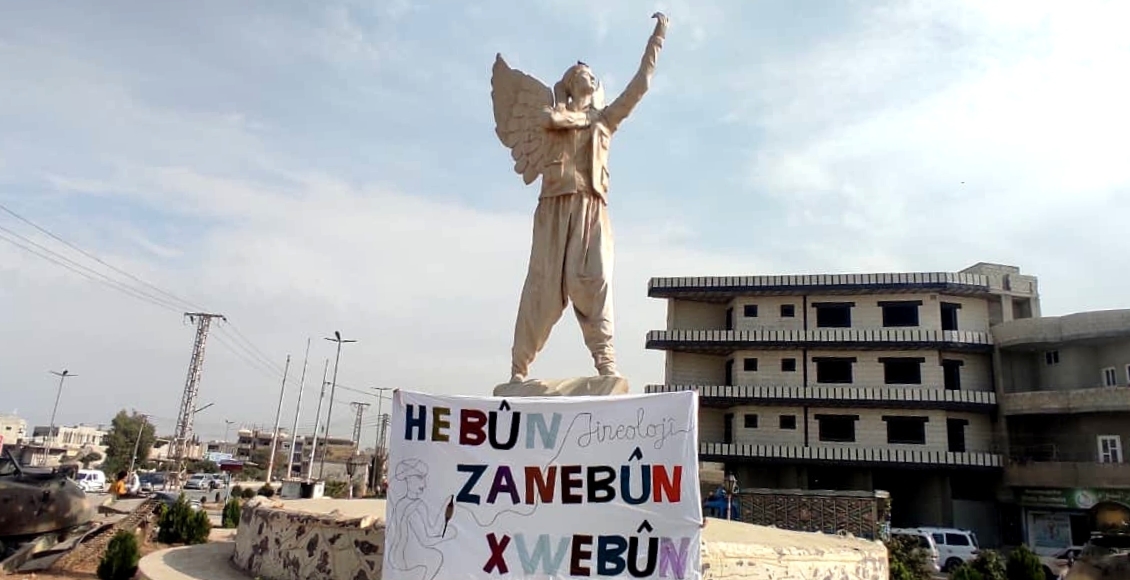
Hebûn – Zanebûn – Xwebûn: On hamster wheels, dangerous menus and democratic integration in the age of the Third World War
Lena Wilderbach
Between war and everyday life, ideology and intimacy, a multi-layered picture of our present unfolds.. a world in which existence is not a given, but must be defended time and again. The war of our time is also a war over the question: How to live? Drawing on the concepts of Hebûn (being/existence), Zanebûn (knowledge) and Xwebûn (becoming oneself), this essay embarks on a journey through the visible and invisible front lines of a Third World War that has long since ceased to be waged solely in military, political and economic terms. Between hamster wheels, geopolitical menu recommendations and the ‘death of the brotherhood of peoples’, the focus is on the unwavering search for a free communal life and on the HOW of our existence. It is about meaning, love, organisation and how we can conceive of and build free life together.
I. HEBÛN means Being, Existence
There are moments when pure existence, pure life, is in danger. In times of war, we feel this all the more keenly. War means threat, fear, devastation, denial, rape, death, the destruction of the foundations of life. In the current phase of capitalist modernity, which we understand as the Third World War, war manifests itself not only in moments of open military hostilities, but is omnipresent. It permeates politics, the economy, institutions, technologies, digital media, and even personalities, relationships, thoughts and feelings. At times it is openly visible, bloody and murderous; at others it is more subtle, insidious, creeping in to undermine the very fabric of life, free thought, social cohesion, and the integrity of bodies and the earth.
What the slogan “Capitalism is war” expresses in a nutshell is something we can clearly see before our eyes in these times. The destructive power of capitalist modernity is reflected in the systematic crises and states of emergency in which people and societies are caught. We see that many people are preoccupied day in, day out with coping with crises and running on hamster wheels in fear for their own existence and future. The perpetuation of existential crises is no accident, but part of the system. It leads to people, movements and societies becoming weary and hopeless, and unable to muster a collective force against the system. For those who struggle daily for survival and the recognition of their own existence will, in most cases, initially put questions about the form of that existence – be it political, social or philosophical – on the back burner.
In his perspectives for the 12th PKK Party Congress, Abdullah Öcalan writes: “I would like to begin with the topic of ‘awareness of existence and the Kurds’ perception of their own existence’. There were, of course, the well-known questions: ‘Do Kurds exist or not? If so, to what extent have they been able to realise their existence? And above all: to what extent are existence and freedom intertwined, and how do they condition one another?’ ”1
Who are we? To what extent is our existence intertwined with freedom? We should ask ourselves these questions not only as Kurds, but as people and societies across the world. What does it mean for us to live in these times of the Third World War and to defend our existence?
The struggle for existence is ultimately not merely physical, but deeply connected to the question of the HOW of existence. How do we want to live? What forms of existence are imposed upon us by the system of capitalist modernity? And above all: how do we free ourselves from this and collectively create alternatives for a free life?
The death of brotherhood and the HOW of existence
In Kurdistan, the Middle East and far beyond, a fierce ideological war is currently being waged alongside military interventions. Linked to developments in Rojava and Syria, images and statements have been circulating on digital media profiles in recent weeks proclaiming: “The paradigm has failed!”, “The brotherhood of peoples has failed!”, or even: “Death to the brotherhood of peoples!”
As an initial emotional reaction to the massacres and abductions committed in January and February in north and east Syria by the troops of the Syrian Interim Government, this is understandable at first glance. The defection of some Arab units of the SDF to the troops of the Interim Government sparked a debate about how opportunistic or sustainable these alliances had been. Undoubtedly, the organisational structures in Rojava and north and east Syria are undergoing a necessary process of reflection and self-criticism in this regard.
However, anyone who has followed the debates in the digital media will quickly recognise that the propaganda against the ‘brotherhood of peoples’ is part of a wide-ranging and heavily fuelled anti-propaganda campaign against the perspectives of the Kurdish freedom movement and the paradigm of democratic modernity. As in all eras and struggles across the world, we can clearly see how narratives are shaped to cement the ruling powers’ version of history.
We recall other proclamations, such as the famous “end of history” proclaimed by Francis Fukuyama in 1989. At the time, he was referring to the seemingly absolute victory of liberal democracies and the capitalist market economy over all other social models, particularly socialist ones. In the “failure of the brotherhood of peoples”, we now find a similarly powerful narrative in the context of the hegemonic reordering of the Middle East. Such narratives are not accidental, nor do they simply exist in a vacuum; rather, they have a specific ideological background and serve particular interests. They seek to cement a specific definition of existence.
This narrative is linked to the deliberate stoking of racist-nationalist and political hostility between the various population groups in north and east Syria and across the entire region. This is further fuelled by provocations such as the attacks on the Kurdish population during this year’s Newroz celebrations in Afrin and Aleppo. In the context of the hegemonic reorganisation of the Middle East, these actions are intended to act as a stab in the back against the achievements of democratic coexistence among the peoples of northern and eastern Syria, and to undermine faith in the possibility of democratic self-administration.
A woman who witnessed the attacks on Aleppo’s Kurdish neighbourhoods at first hand in early January summed it up aptly: “What we are experiencing today is not a local matter, but rather a regional earthquake intended to bury every spark of hope for a democratic future in the Middle East.”2
Existence – between powerful tables and dangerous menus
All this is happening at a time when we are confronted with fundamental shifts in power and struggles for hegemony. It is a war over a changing world order, being waged on many fronts simultaneously. We see how the various powers are positioning themselves within it, each with their own interests and tactics.
At the World Economic Forum in Davos in January, Emmanuel Macron said: “Look at the situation where we are. I mean, a shift towards autocracy, against democracy. More violence, more than 60 wars in 2024 – an absolute record, even if I understood a few of them were fixed. And conflict has become normalized, hybrid, expanding into new demands, space, digital information, cyber, trade and so on. It’s as well a shift towards a world without rules. Where international law is trampled underfoot and where the only laws it seems to matter is that of the strongest.”3 Canadian Prime Minister Mark Carney went on to remark: “We are in the midst of a rupture, not a transition.”4 With regard to Canada’s situation, he put it bluntly: “the middle powers must act together, because if we’re not at the table, we’re on the menu.”5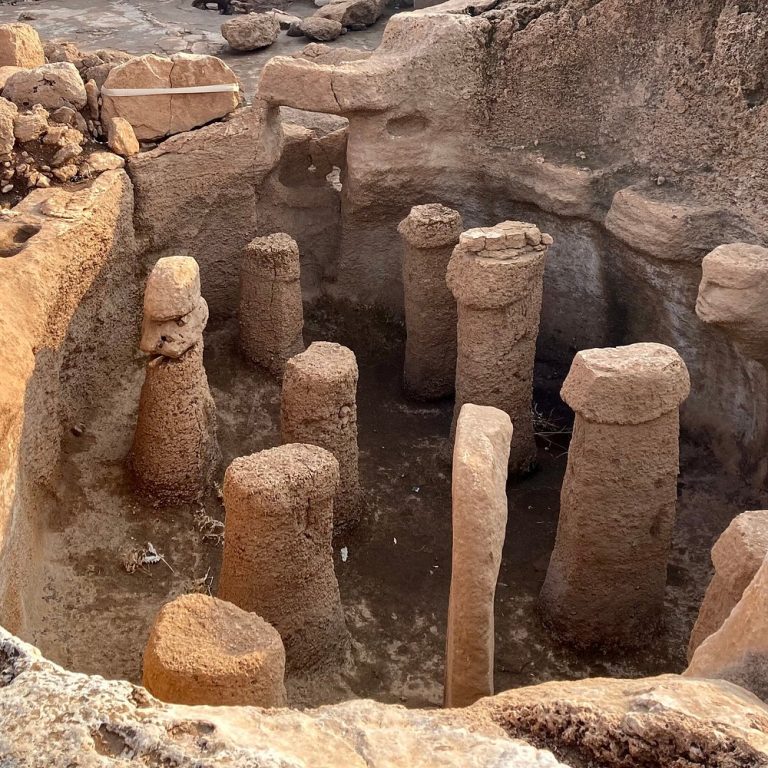
From Trump to Merz to Macron and Carney, they are all, in one way or another, talking about defending the very existence. They advocate for the control of national borders, militarisation, rearmament, massive arms deals, or collaboration with other powers – either to exploit or to outmanoeuvre one another – so as not to end up on the menu. In early March, during a speech to the French armed forces (which, among other things, concerned nuclear rearmament), Macron chose particularly dystopian words: “For in this dangerous and unstable world, as I have said many times before: to be free, one must be feared.”6 And further: “To be free, one must be feared; and to be feared, one must be powerful.”7
Statements like these, which are presented as security policy realism, essentially reveal to us the purest form of patriarchal logic: to be free, you must be so powerful that others fear you. But if one’s own existence and freedom are based on the fear and thus the subjugation of others (and possibly even depend on the potency of one’s own missiles) – what sort of ‘freedom’ are we talking about then? The way in which politics is negotiated in capitalist modernity repeatedly and painfully brings home to us the tragic absurdity of patriarchy.
The situation we find ourselves facing in these times was already analysed in depth, both historically and sociologically, by Abdullah Öcalan many years ago in his defence writings, and described by him as the Third World War. The paradigm of Democratic Modernity, to which the freedom movement in Kurdistan and, increasingly, wider circles worldwide are now referring, builds upon these analyses and formulates a contemporary alternative. This states: Social existence and freedom cannot be defended in the long term through patriarchal dominance, militarisation, isolation and control. Instead, the aim is to realise and defend existence as free people and free societies by establishing structures of democratic self-administration. Öcalan thus formulates a perspective that is radically opposed to war, colonialism, capitalism and patriarchal power structures – a strategic horizon and practical alternatives for the Middle East and the whole world.
II. ZANEBÛN – Knowledge and Consciousness as the Foundation of Human Existence
Life is not merely physical existence. If we are to understand the war of our time and the struggles over the paradigm, we must understand the role of knowledge, consciousness and meaning for people and societies. Who are we and what can we become? What defines our existence as human beings and as societies? Is it solely our biological existence as a human species, the conversion of energy through food intake, biological reproduction? Does the mere physical presence of one or more ethnic groups on a territory constitute a society?
To find answers to these questions, we must look very deeply into the roots and fundamental conditions of human existence. In the newly published Manifesto of the Democratic Communal Society (Demokratik Komünal Toplum Manifestosu), Abdullah Öcalan also asks what constitutes human existence. How the universe came into being, the tiniest particles in motion, protons, neutrons, electrons, from which atoms are composed, atoms that are in constant exchange and which, through complex forms of organisation, combine to form molecules, from which in turn cells, organisms, algae, plants and animals develop. They arise with the cycles of time, grow, multiply, perish, and the particles of which they were composed transition back into other forms of existence. Over the course of evolutionary history, living beings on Earth developed into an enormous diversity, and thus the human species also came into being. In this sense, humans are part of biological nature, of the ecological world. “The life of cells thus develops in dependence on exchange or organisation. Is it possible that this property of cells is connected to human sociology?”8
Humans are ecological beings. And we can also understand them as social and thinking beings. A look at the evolutionary and cultural history of humanity reveals to us the deep imprints of communal life: humans are social beings. This is not about individual inclinations or lifestyles – such as whether someone prefers to live alone or manages on their own for a while as a self-sufficient individual. Rather, sociality is a fundamental condition of human existence. This becomes particularly clear at birth: whilst the young of many other species are often able to stand on their own feet and survive after just a few days or weeks, a human baby needs many years to grow up. It is dependent on food, protection and care – not only from the mother, but also from an entire ecological and social environment.
The need for connection, care and cooperation forms the basis of communal life. Even in early human communities and clans, the care organised around the mother gave rise to a form of communality that forms the core of social coexistence. We can only exist by supporting and sustaining one another – biologically, economically, psychologically and, not least, through interpersonal connection, recognition and love. The fact that this fundamental reality of connection and mutual dependence is obscured, exploited and alienated to the utmost in capitalism is one of its central contradictions.
At the same time, humans are thinking beings. It seems that the complex nature of human thought and the way in which we create culture and meaning set us apart to some extent from other animals. Building upon their first nature—their biological or ecological nature—humans have, in the course of their development, cultivated a second, social nature: a world of language, culture, values and meanings. This social nature is continually created, shaped and passed on by society itself.
The new manifesto states: “Society is not merely an association of people. It is a system of values produced by people and through which they realise themselves via collectivity. The constitutive, sustaining and developing element of all social structures is meaning. Society (…) is both subject and object of its own becoming, which has an open character. In other words: society is a continuous process of construction, decay and reconstruction. Ultimately, this social nature is brought about by human beings. It is a reality that forms around the human species.”9
And precisely because social reality is created and transformed by society itself, sociality does not rest on strict natural laws of cause and effect. It is more flexible and is shaped instead by tendencies and possibilities. As human beings, we are deeply connected to this social reality: we grow into it; our worldview and our entire lives are shaped by it.
That is why meaning plays such an existential role for us. Our understanding of ourselves and the world, what we perceive as true, right or good, is closely linked to how we have experienced it around us since childhood. Throughout human history, what has initially held significance is that which enables, nourishes and protects life: motherhood, care, community, the earth, the sun, water and food are therefore often regarded as sacred. With the development of domination and patriarchal structures, however, we see how destructive values and meanings can take hold: Violence, dominance and exploitation are normalised or even portrayed as necessary and legitimate, even though they contradict life itself. Meaning is not simply an abstract or metaphysical dimension of human imagination. It is tangible, perceptible, material, part of social reality. It moves people to behave in certain ways and can also be enforced through manipulation and violence.
Take, for example, national borders.. In the first, biological nature, they have no reality. Migratory birds simply fly over them, and the history of humanity has always been shaped by nomadism, migration and cultural exchange. The concept of national borders, on the other hand, has been created, institutionalised and enforced throughout history as a result of politics centred on power, capital and domination. And so, today, national borders have a material meaning and reality: they define territories, dictate freedom of movement, tear societies apart, impose assimilation, and have cost countless lives throughout history. And yet, all too often, their legitimacy is not questioned at all.
Zanebûn means knowledge. Gaining knowledge (zanebûn) and consciousness (hişmendî) of our history and society means being able to understand our own existence and situation in a completely different way. We can challenge seemingly overwhelming realities and see more clearly in which hamster wheels of capitalist modernity we are wearing ourselves out. Seeing the potential of a free life and understanding when and how certain power structures have developed throughout history allows us to realise that things can be very different. That is why knowledge and consciousness are a fundamental prerequisite for liberation.
Giving meaning and creating a culture of free life
The deeper our knowledge and consciousness, the more our ability to give meaning and create meaning becomes a great productive force for liberation. The Kurdish freedom movement shows us how, through the tradition of the struggle for freedom, combined with a broad social movement, new meaning can be created.
An entire culture has even grown up around the freedom movement. It is deeply rooted in a shared history, common experiences and lived struggles. It is founded on values that were forged with great dedication and effort, and for which many sacrifices were made. And it continues to grow – through collective memory, practice, reflection and renewal. It combines living history, the commemoration of the Şehîds, values, principles, music, dances, symbols, concepts and words, right through to practical working methods and approaches to organised communal life. At times, we even see how nationalist and capitalist forces seek to imitate this culture and exploit it for their own interests. But in the end, this produces only a distorted and hollowed-out image. It is a culture that can be lived, but not imitated. It is open and accessible to all who share its values – but it is not an artefact that can be bought and donned like a crown. Its power and beauty arise from the unity of essence (cewher) and form. This example tells us a great deal about the power that can emerge from social struggles. If we have the courage to question the destructive values of capitalist modernity and instead give meaning to, and strengthen, that which truly brings us closer to freedom and in which lies the potential for a good and more just life for all – then we set out on the path to creating a culture of free life. All this makes it clear why the struggle for the paradigm is so essential. For the struggle for the paradigm is also a struggle for meaning. And the struggle for meaning is linked to the struggle for the HOW of existence.
A laughing ethic of existence
When it comes to Rojava, one occasionally hears journalists or commentators explaining the situation with fervent rationality and claiming: Rojava is by no means about revolution or alternative paradigms, but about access to mineral resources. “Perhaps for you,” I then think – because what Rojava is about depends on one’s perspective. And in front of my eyes I see all the people in Rojava: mothers, daughters, grandparents, workers, gardeners, teachers, fighters, who are giving their lives for this revolution.
It is mad that we live in times when insisting on fundamental ethical values can be dismissed as naivety. Yet we must start precisely there and break with the unbearable normalisation of the brutality of capitalist modernity. In times like these, the defence of social and ethical existence is highly political.
Anyone who, in the face of the Third World War or the Epstein Files, still clings to the nihilistic notion that any attempt to develop an ethical alternative to capitalist modernity is naive, is not being critically cautious, realistic or impartial, but is quite clearly taking a stand in defence of a destructive and absurd system.
As I write this text and reflect on meaning and the death of brotherhood of peoples, a memory comes to mind.. N, an Arab frien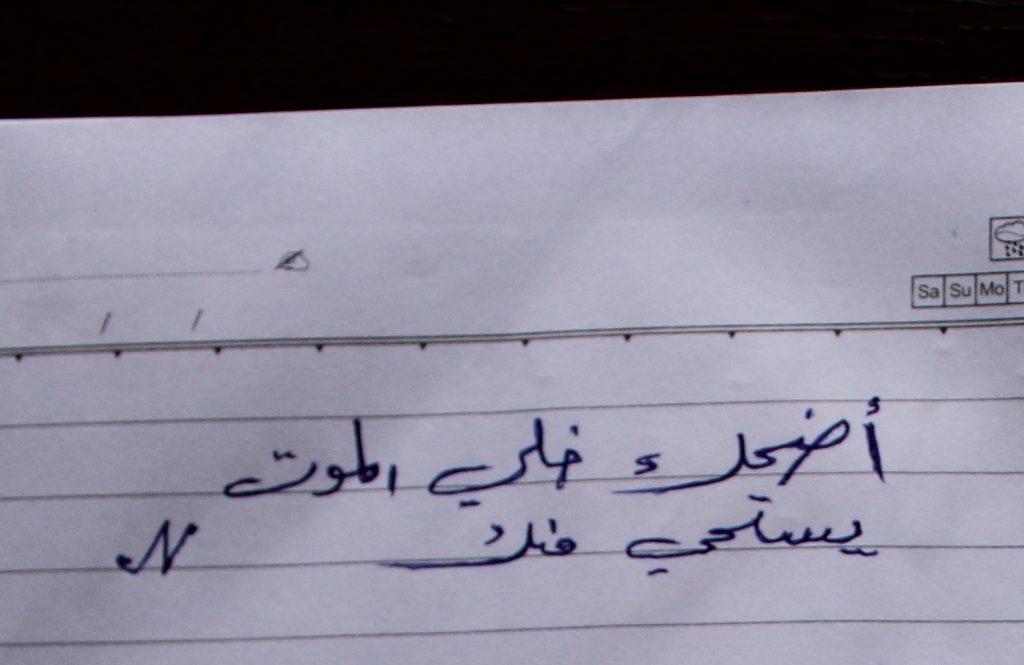 d with whom I lived for a while in Rojava, had written a sentence in my notebook as a memento. She herself grew up in an Arab tribe, married young, separated from her violent husband after a short time, and had become part of the freedom movement. The sentence she wrote in Arabic in my notebook is the title of a book by Xeyri Garzan, in which he writes about the life of the guerrillas: “Gölümse, ölüm utansın.” – “Laugh, may death be ashamed.” At a time when we are frequently confronted with violence and death, I think of this friend and why she wrote this sentence in my notebook. It is a reminder of what it means to dedicate one’s life to the struggle for freedom. What does a smile mean in the face of death and destruction? The laughter referred to here, a laughter that makes death be ashamed, is not a forced smile that masks insecurities or pain. It is a laughter that reveals a deep connection with life. A laugh that refuses to be humiliated, but instead defies injustice and formulates a vibrant resistance against the devastating fury of destruction. A resistance that defends, from the depths of the heart, an ethical life and the coexistence of peoples in dignity and freedom.
I am also reminded of Gisèle Pelicot’s “Shame must change sides”10, which in these times could become the slogan for a broad movement. If we are aware of the values we stand for and what is wrong, and if we make this awareness a shared standard that we also know how to defend in practice, then we have the power to shift societal frameworks of meaning and realities.
The paradigm of capitalist modernity proclaims again and again: either you bow to the realities of the system and play the game at the tables where the hegemonic powers are playing it – or you will be devoured. The significance of the paradigm of democratic modernity for our times lies precisely in the fact that it resists this logic of the system. Based on a sound historical and sociological analysis, a healthy dose of geopolitical realism and a radical ethic of freedom, it allows us to step out of the hamster wheels; it opens up new horizons of imagination and avenues for social and political agency.
III. XWEBÛN means becoming oneself
We now come to the dimension in which existence and consciousness find their expression: Xwebûn. Xwebûn means being oneself and becoming oneself. We sometimes also speak of têşê girtin, which means taking shape. In the political philosophy of the Kurdish freedom movement, and particularly the women’s movement, Xwebûn means freeing oneself from all imposed forms, and, step by step, through a process of consciousness and liberation, becoming oneself: becoming aware of one’s own existence, one’s own identity, one’s own will, and giving them form.
Our existence is linked to the existence, history, life and freedom of the others. That is why becoming oneself and self-liberation always also mean collective, social liberation. Xwebûn – not only as an individual woman, as an individual human being, but also collectively: as a commune, as a movement, as a society.
The experiences in Rojava demonstrate the power that lies in collective self-realisation. Yüksel Genç wrote on this: “What is developing in Rojava and beyond is a profound political shift: a threatened minority has become a self-assured, transnational political subject with growing influence, but also growing responsibility. The unity that has emerged is not perfect, but it is real. And it is changing the political landscape.”11
Existence is physical, it is ideological, it is political – and it is realised through organisation. Or, as Abdullah Öcalan puts it in the new manifesto: “You exist to the extent that you are organised.” And he continues: “We have seen this for ourselves when we tried to define the Kurdish structure; we exist to the extent that we are organised; we are destroyed to the extent that our organisation is scattered. It is obvious that organisation is what makes existence possible in the first place.”12
Just as atoms combine to form molecules and thus constitute the materiality of life, societies too are realised through the form of their organisation. Organisation means giving form to our shared existence. Especially in these times, the question of organisation is existential. We must organise ourselves against the imposed war and patriarchal violence, against the permanent states of emergency, isolation, division and threats with which we are confronted in this Third World War. But what forms of organisation are needed to allow freedom and self-determination to flourish? And on what can they be founded?
Beyond brotherhood and the nation-state
Anyone who these days publicly spits on the ‘brotherhood of peoples’ and sets it against the ‘brotherhood of the Kurds’ is constructing a contradiction that does not actually exist within the paradigm. For, according to the paradigm, the ‘brotherhood of peoples’ and the freedom and self-determined existence of Kurdistan are mutually dependent.
If one looks at it more closely, one could even argue that the term ‘brotherhood’ does not actually fit the paradigm all that well. In Kurdish, those close to the paradigm usually speak of ‘xwişk û biratiya gelan’13 (‘sisterhood and brotherhood of peoples’), thereby distancing themselves from a purely male perspective. Emphasising the sisterhood and brotherhood of peoples is an important part of the democratic-socialist and internationalist tradition of the freedom movement and refers to solidarity among (oppressed) peoples.
That said, what resonates in the familial term ‘brotherhood’ is not actually what the perspective of the democratic nation and democratic confederalism is working towards. ‘Brotherhood’ does indeed refer to a traditional ethos of loyalty and cohesion. However, the cohesion of brothers is based on blood ties and can therefore also imply male cliques and nepotism. In other words: there are no ethical-political principles or standards behind it to begin with. It is not for nothing that the paradigm of democratic modernity aspires to more than a nation-state of brothers. Rather, it is about the democratic nation and a democratic coexistence of peoples based on ethical and political foundations. Abdullah Öcalan argues that the attempt to force the multi-layered reality of societies into a state-centric nationalism offers no prospect of a solution. Rather, this leads to a perpetuation and deepening of conflicts: “If the nation-state solution is imposed, five states on the same land will be in permanent conflict with one another.”
Since the 1990s, Abdullah Öcalan has criticised the organisational form of the nation state, and these critiques and analyses have been widely discussed and further developed within the Kurdish freedom movement. Öcalan analyses both the lessons to be learnt from the history of the Middle East and the experiences of so-called real socialism as well as anti-colonial national liberation movements. The dream of the nation state as a guarantee of the freedom and independence of peoples – whether bourgeois or socialist – is a myth. Particularly in the Middle East, the construction of nation-states was not an achievement of the peoples, but an instrument of imperialist intervention and divide-and-rule policies. Instead of leading to freedom and self-determination, the drawn state borders led to more conflict, assimilation, corruption and the destabilisation of the region. Even post-colonial states in the Global South that managed to achieve formal independence often remained entangled in colonial dependencies, and the development of democratic structures of self-administration is very difficult. “Maduro also had a nation-state…” a friend remarked recently. Yes, if the nation-state alone were a guarantee against external intervention or anti-democratic tendencies, then what happened with Maduro would probably not have occurred.
The new manifesto puts it very clearly: “Under the conditions of capitalist modernity, every nation is defined in terms of the nation-state, and it is treated as if it were a universal law that one must develop into a state in order to be a nation. In contrast, the building of a democratic nation does not take place through the nation-state, but through self-administration. What is important here is that society is administered not by an external or ruling power, but by itself. In a democratic nation, the foundation is not foreign rule, but self-administration.”14
Öcalan is nevertheless repeatedly criticised by both nationalist and orthodox Marxist quarters, and indeed his perspectives go beyond classical theoretical frameworks and concepts in many respects. With his critique of the state and his focus on women’s liberation, communalism, democratic confederalism and democratic integration, he has neither “abandoned” nor “betrayed” Kurdistan – as some voices of anti-propaganda notoriously claim. On the contrary: he deepens and updates analyses of power and society, critiques dogmatic approaches, formulates the most apt contemporary theses, and raises a thoroughly uncomfortable question: how freedom movements must reorganise themselves today so as not to remain stuck in nostalgia, but to be able to wage effective struggles for freedom against the system of capitalist modernity.
On becoming oneself and self-administration: the commune and communalism
Becoming oneself is thus linked to self-administration. And the basis of self-administration is the commune – as the smallest unit of social organisation. Communes can take on a wide variety of forms. Abdullah Öcalan writes: “The foundation of society is the commune. For social existence to thrive, it must be revived today. Essentially, democratic society is based on self-administration and self-defence. Communalism is the name of the democratic social system. This system incorporates differences and does not accept approaches developed on the basis of faith or ethnicity that aim to divide and create discrimination.”15 “Communes are a fundamental need of society; they are self-administration. The commune is the stem cell of the democratic nation. If the cell is not healthy, neither is the body. In this respect, the commune is vital. The most important task of a society—the most significant in moral, scientific and aesthetic terms—is to attain the power of self-administration.”16
As a concrete vision for Kurdistan, Öcalan proposes a model of confederal organisation, ranging from the smallest commune to the Union of Democratic Communes of Kurdistan, and forming a Communal International on a global scale.
He also describes the establishment of the necessary structures of democratic self-administration and the accompanying upheavals of power as a “positive revolution”: “The difference of the positive revolution lies in building a democratic society and a democratic nation based on communalism, without engaging with power and the state. That is to say, we will build our own world. The state is not overcome through destruction, but by restricting the state’s sphere of influence through the development of communalism.”17
Above all, this resonates as a call to action: Get off your backsides! Unite! Organise yourselves! Build your institutions! Deepen your connections! For the stronger and more conscious the democratic self-organisation is, the more the state is forced to recognise it.
Democratic integration: sitting at the table or ending up on the menu?
These questions are not just about a philosophical thought experiment, but about very concrete socio-political issues – in a war where life and death are at stake. These days, the topic of ‘integration’ is one of the most hotly debated issues in this regard. This raises very concrete and practical questions: What is the future of the peace process in Turkey? What lies ahead in Rojava? Can the achievements of the revolution be defended, and what will all this look like in practice?
“There’s a lot of talk of ‘integration’ these days, but not of democratic integration,” a friend remarked in a conversation recently. “I think we need to understand this concept much more deeply…” In the classical understanding of capitalist nation-states, “integration” usually means adaptation. That is, being fitted into an existing dominant order from a marginal position. This is often synonymous with assimilation, subordination, the abandonment of one’s own identity and capitulation.
The concept of democratic integration, as Abdullah Öcalan has shaped it in recent months, however, rejects assimilation and subordination. Democratic integration in this sense is based on recognition, self-organisation, knowledge of history and mutual transformation. It means, first and foremost, the recognition of local democracies within the state. The new manifesto states: “Democratic integration means not accepting the solution of the nation-state. The nation-state is based on denial, assimilation and annihilation. It is obvious that a nation-state which accepts integration and has declared itself willing to negotiate on this matter will move away from these characteristics. Therefore, integration must be regarded as the fundamental solution to remedy the damage caused by the nation-state in our region and to re-establish a community of peoples.”18
This raises important questions: “Are the nation-states of the region truly ready for integration? Or what do they mean by integration? Are they genuinely opposed to assimilation? Negotiation processes and dialogue are essential for answering such questions. Solutions cannot be found by clinging to old prejudices or by placing the suffering experienced at the forefront of discussions. Just as the democratic, socialist opposition forces courageously discuss the dogmatic dead ends and mistakes of socialism, so too must the ideologues and political centres of the nation-states face up with the same sincerity to the crimes and mistakes committed in the name of the state for more than two hundred years.”19
Abdullah Öcalan also emphasises that democratic integration cannot be achieved with dictatorial, monarchist or fascist governments. As long as the republic does not democratise, democratic integration is not possible either. For these processes are mutually dependent. Furthermore, he stresses that such a process can only be advanced on the basis of democratic politics, democratic negotiations and a legal framework. The legal status, the anchoring of democratic rights and their full recognition are therefore also crucial. Democratic integration means not annihilating one another, but rather, with historical awareness, being conscious of commonalities and differences and creating profound democratic changes through a dialectical process of contradictions.
These days, the contradictions, shortcomings and pitfalls of such a process are being debated in particular, and there is anxiety about the possibility of success. Abdullah Öcalan made an important remark in his perspectives for the 12th Party Congress. He quotes Şêx Seid, leader of one of the great Kurdish uprisings, who was sentenced to death:
“Mr Prosecutor, you promised that we would dine on lamb together. What has become of that?”20
No lamb, no dignified meal at a shared table, no negotiations – instead, Şêx Seid was executed in Amed in 1925. This example serves as a warning not to indulge in reckless expectations and not to rely on certain norms being upheld. It seems to call out to us: learn from history, remain vigilant and do not repeat the mistakes of the 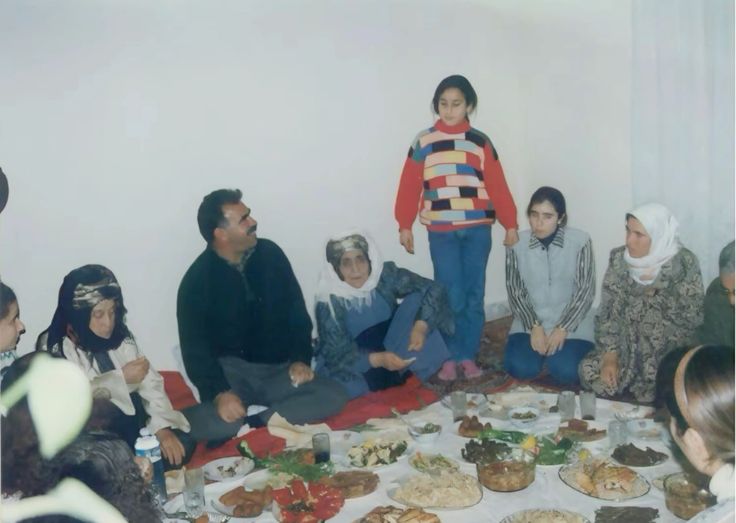 past. To sit at the table or end up on the menu? If one follows the narratives of the politicians at the World Economic Forum, it seems that the Third World War is presenting us with this choice. Abdullah Öcalan and the Kurdish freedom movement have opened up an alternative path amidst all this chaos. The path of the democratic nation means neither playing along with the game of the hegemonic powers and allowing oneself to be lured by their dubious menu recommendations – nor giving up and allowing oneself to be devoured. Whereas in the history of earlier Kurdish uprisings collaboration with the ruling powers or execution at their hands dominated, Abdullah Öcalan has managed to set a table – a table of negotiation for the dignity and freedom of existence.
Democratic integration is perhaps a bit like a tightrope walk, like the art of sitting at the table without sitting at the table.21 To do everything for the recognition of societies’ existence and for the truly democratic coexistence of peoples, without getting drawn into the games of the hegemonic powers. And always to know:
The table that really matters is not the table of the ruling powers, but the simple sofre22 of commual life. Coming together around communal labour, creativity, values and meaning.
Yes, democratic integration can only be realised if the democratic foundation of society is strong. In other words: if we organise our lives communally in all areas.
Not least, this also means not relinquishing the right to self-defence: “Renouncing armed struggle and the strategies and tactics based on it does not mean renouncing the right to self-defence. To renounce the right to self-defence without the Kurdish existence as a democratic society being secured would mean digging one’s own grave.”23
Just as with the underlying consciousness, the practical steps involved in organising democratic sociality must be continually developed. “Questions such as: where and how to begin, what stance to adopt in negotiations, what language, style and methods to use in building institutions and putting theory into practice, are at least as important as the creation of the theoretical framework.”24
Xwebûn: How to live?
The journalist and guerrilla fighter Gurbetelli Ersöz noted in her diary: “Practical creativity. Practical politics. That is the pivotal point. Theory is only successful to the extent that it is put into practice.”
In the paradigm of democratic modernity, revolutionary perspectives and a radical ethic of dignity and freedom are combined with political realism and a utopian element – and, above all, a very long road still ahead of us. We find ourselves in a new phase in which it will become clear how much has been built up in recent years and how we will continue to develop and defend all of this together. And as Abdullah Öcalan writes in Beyond State, Power and Violence: “The struggle for peace and democracy is harder than any military battle.”25
So what should we do in these times?
In Kurdish there is a beautiful expression: “buyina bersiv”, which literally means “becoming the answer”. This is not merely about providing a response to a situation, like a reflex to a stimulus – but about becoming the answer oneself. And ultimately, that also means Xwebûn. It is about us, in these historic times, becoming the answer together. As women, as societies, as a movement – locally, regionally and globally. It is up to us to organise and defend our quest for a free, dignified life in deep connectedness across all borders. This requires historical consciousness, foresight, a clear ethical and ideological stance, practical organisation and a lot of creativity. And for this end, we will intertwine Hebûn (existence), Zanebûn (knowledge) and Xwebûn (self-realisation) just as artfully and unwaveringly as our braids.
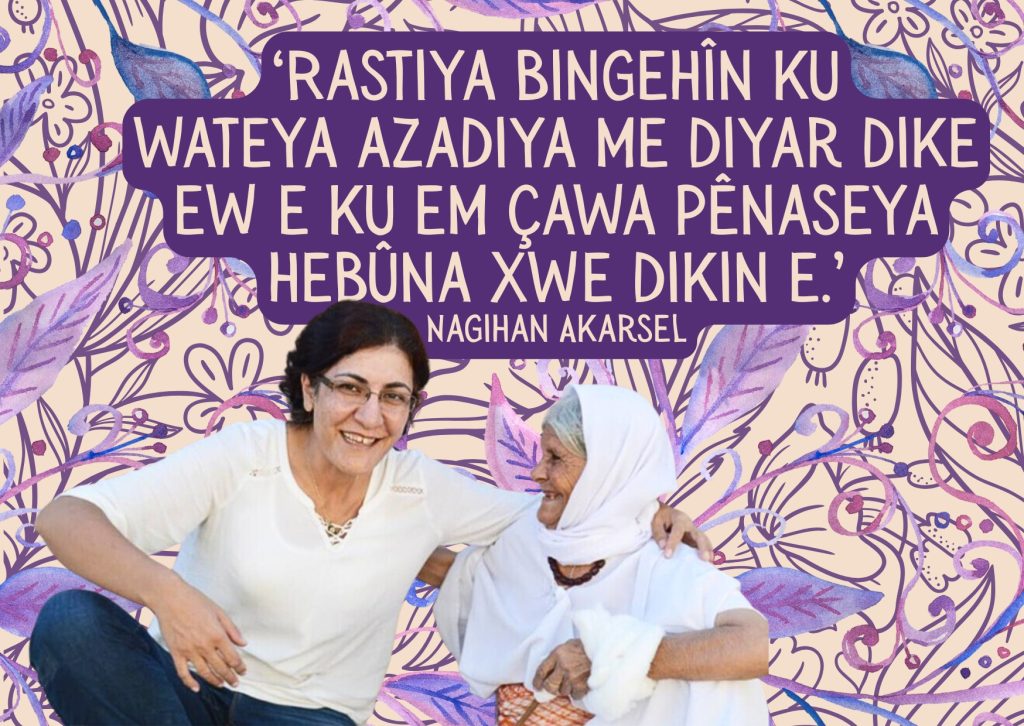
1 Kurdish: “Ez dixwazim bi mijara ‘Di Kurdan de serwextbûna hebûnê û hay jê hebûn’ dest pê bikim. Ew nêzîkatiyên binavûdeng yên wekî; ‘Kurd hene yan nîn in? Heke hebin çiqasî bûne hebûn? Ya herî girîng jî, ev hebûn û azadî çiqas di nav hevdu de ne û çiqasî hevdu pêkan dikin?’”
2See: https://jineoloji.eu/de/2026/01/31/das-leben-verteidigen-stimmen-aus-belagerung-und-widerstand-die-frauenkommune-in-aleppo/
3https://www.weforum.org/stories/2026/01/davos-2026-special-address-by-emmanuel-macron-president-of-france/
4https://www.weforum.org/stories/2026/01/davos-2026-special-address-by-mark-carney-prime-minister-of-canada/
5ibid.
6https://www.lepoint.fr/politique/pour-etre-libre-il-faut-etre-craint-le-discours-integral-demmanuel-macron-a-lile-longue-sur-la-DFQAQP2445GH5FKY54WGM3HMTY/
7ibid.
8Provisional translation by the author, from: Demokratik Komünal Toplum Manifestosu. Weşanên Meyman: 2026
9ibid.
10 The phrase “La honte doit changer de camp” (Shame must change sides) was coined by Gisèle Halimi even before Gisèle Pelicot, back in the late 1970s. She was a Tunisian-born lawyer, feminist and anti-colonial activist who became particularly well-known for her defence work in political trials during the Algerian War. Gisèle Halimi struggled for women’s rights, particularly in the context of sexualised violence (including in the case of Djamila Boupacha). She drew attention to the intertwining of sexist and colonial violence.
11 https://deutsch.anf-news.com/kurdistan/rojava-als-katalysator-neue-rolle-der-kurdischen-bevolkerung-50279
12 Provisional translation by the author, from: Demokratik Komünal Toplum Manifestosu. Weşanên Meyman: 2026
13 In Turkish, the word is ‘kardeşlik’, which means ‘siblinghood’ and is a gender-neutral term.
14 Provisional translation by the author, from: Demokratik Komünal Toplum Manifestosu. Weşanên Meyman: 2026
15 ibid.
16 ibid.
17 ibid.
18 ibid.
19 ibid.
20 The extended quote in Kurdish: “Gotinên Şêx Seîd yên dawî çi bûn? Pirseke wiha dipirse: “Dozger beg, ka te gotibû em ê bi hev re berx bixwin” Ev xefleteke olî ye, ji ber ku şêxekî oldar yê Neqşî ye. Di esasê xwe de îfadeya xapandineke trajîk a bikovan e. Nîşan dide ku, di ew bîrdoziya xwe radest kirî de çiqasî hatiye xapandin. Vê radixe ber çavan.”
21 Quantum!! 😉
22 Sofre traditionally refers to the cloth laid on the floor for communal meals.
23 Provisional personal translation, from: Demokratik Komünal Toplum Manifestosu. Weşanên Meyman: 2026
24 ibid.
25 Cf. Öcalan, Abdullah (2010): Beyond State, Power and Violence. Defence Writings. Cologne: Mezopotamien-Verlag