
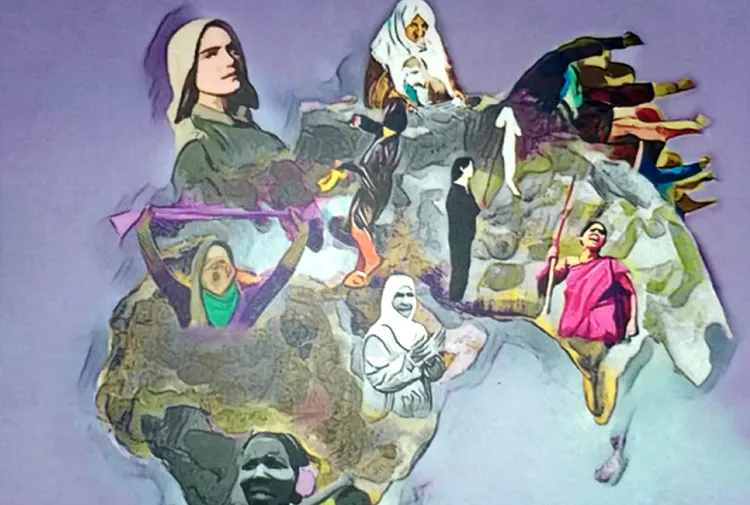
A Form of Existence That the Present Age Seeks to Devour: Resistance
From: Jineolojî Magazine, 11th Issue, December 2018
Fatma Koçak
One of the greatest problems of our time is the consumption, use, and devaluation of concepts that have crystallised out of life and history — concepts for which a high price was paid — into definitions that increasingly resemble trivialities.
We live in an age in which concepts, identities, and belongings are squandered and consumed. In capitalist modernity, every quality with which individuals describe themselves, and every deviation they highlight in order to distinguish themselves from the general public, flows into the market pool shaped by the patterns of consumer society, and so this frenzy of consumption continues ever further. It begins in minds where, as the elders used to say, “the tracks of the horse are mixed with the tracks of the dog.” In the age of capitalist modernity, where a lifespan is assigned to human beings, to nature, and to all living things, the concept of “resistance” too is beginning to become a consumed, worn-out, and outmoded rhetoric.
“Resistance” — which has manifested itself as an immutable law since the birth of the universe, since the emergence of life and the first human beings on earth — is losing its meaning. Throughout history, resistance has always been one of the most effective acts of those who sought to preserve and further develop their existence against those who rule and oppress. Resistance is the most virtuous and simplest form of being in the memory of the universe — against the hegemony of patriarchal power, which is ever watchful and aggressive, operating on the principle that “the stronger always wins.” Peoples and living beings know this very well. This form of resistance, which does not appear in written, human-centred, and patriarchal history, is a reflex of life itself.
When a cat is cornered, it chooses resistance and defends itself with its claws; when someone tries to pick a rose, it attempts to prevent this with its thorns and resists; a bird whose nest is disturbed moves it to another place and resists; bees whose hive is prodded with a stick defend themselves with their stings and drive the intruder away from their hive…
The word “resistance” is defined in the dictionary as “to withstand, to hold one’s ground.” It is an indispensable law of nature for all living beings on earth; it is instinctive, and whether one wins or loses — one inevitably chooses to resist. Perhaps one does not win at a given moment, but over time, resistance becomes part of one’s being. In the forest, for example, one will not find a deer that does not resist the lion; for this is the only rule upon which a living being relies to protect itself against any attack on its existence. One cannot expect a people whose language, culture, and identity are to be erased to accept this in silence. They turn to resistance and ultimately find a way to preserve their existence.
Resistance — which for living beings is synonymous with the preservation of their very existence — has been practised in different forms and methods in every region. If we focus on the experiences and histories that a positivist, male-dominated, and power-oriented understanding of history seeks to conceal behind the veil of the past, the strength, impact, and instructive character of these methods are an important lesson for all of us. History is not merely repetition, as the positivist concept of history claims — yet it is a good teacher.
Fatmagül Berktay summarises this in “The Gender of History” as follows: “Since historiography has been in the monopoly of men since the invention of writing, the deeds and experiences of men were considered ‘historically significant,’ while the experiences of women were pushed to the margins.” She refers here to the words of Gerda Lerner: “If one were to view history from the perspective of women and organise the past according to values defined by them, the history we know would appear in an entirely different light…” 1
History is a living, flowing, and holistic phenomenon composed of past, present, and future, and for those who can see beyond the veils of mist, this phenomenon is the finest teacher for shaping the future. We know that this veil of mist thickens especially — and becomes harder to see through — when it comes to the history of women. It is anchored in the memory of the universe, of human beings and living creatures, which the hegemonic system seeks to destroy. I believe the fundamental source we will draw upon in order to build the system of women lies hidden in the stories of all those women who have lived and resisted throughout history.2 Reviving this memory, from the more recent past to the more distant, will be for all of us the greatest historical consciousness and the finest teacher.3
Without straying too far into the distant past, or to faraway lands, this text concerns some stories from the past century on this earth — stories that speak of the methods of a great historical heritage of resistance.
“I Would Return and Keep Fighting…”
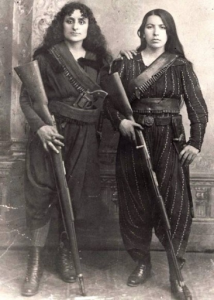 Maryam Çilingiryan and Khanum Ketenciyan are two women who, during the Armenian Genocide of 1915, founded a group of twenty-five women to protect their people, and thus organised the resistance. After the first days of the genocide — when on April 24th, intellectuals in Istanbul were torn from their homes and deported into the unknown — resistance movements began in many places across Anatolia. One of these places was Urfa, and the organisers of the resistance were women. Khanum and Maryam, with the women’s group they had founded, sprang into action to prevent soldiers from entering the residential quarters. Their first action was directed against an Ottoman military station. When they had collected all the weapons from the station and returned to the neighbourhood, the action spread like a wave through the city and gave the population hope. At precisely this time, the Germans intervened and — through a so-called international aid organisation — called upon the population to surrender, announcing: “Those who surrender will be spared their lives.” Since Khanum and Maryam knew this was a trap, they reinforced their resistance positions with the words: “This is a trap, we will not surrender.” The resistance in Urfa was broken by local militias under the command of Ottoman officer Nedim Bey and German Captain Wolffskeel. German artillery units began to destroy the Armenian neighbourhoods. Maryam lost her life during the resistance; Khanum and four of her companions were taken alive. The following dialogue between the Ottoman officer and Khanum is, in these days, like a refreshing of memory.
Ottoman Officer: How would you show your gratitude if I spared your life?
Khanum: I would return and keep fighting.
Ottoman Officer: Your cause is hopeless. What will you do?
Khanum: We will die in resistance.
Ottoman Officer: You will be taken by force. If you wish, you can become my wife. The other girls may choose whichever man they wish to marry. No force will be used; everyone will regain their freedom.
Khanum: You mean with dishonour.
At the end of this dialogue, Khanum draws the pistol she had concealed in her pocket and kills the Ottoman officer. She is then shot, along with her four companions.4
Constance, Who Lit the Spark of Revolt![]()
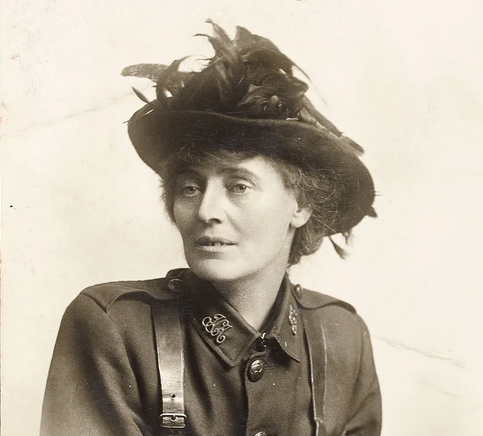
In the days when Khanum was carrying out her dignified resistance, in another region, another woman was writing her own story — one that would remain as a legacy for the future. Constance Markievicz — countess, artist, politician, independence fighter, revolutionary, suffragette, and socialist — in the Irish struggle for independence. Constance was among the first to light the spark of revolt in her country’s fight for independence, known as the Easter Rising, or the “trench and barricade war.” In a poem composed on the battlefield, her childhood friend — who fought beside her at the same barricade — called out to Constance: “Stand up, ask me to light a match…” Under the command of Commandant Constance, the women built barricades, dug trenches, and formed self-defence units to counter the attacks of British soldiers. The women who refused to surrender from behind the barricades went down in history as the “Women of 1916.” The uprising ultimately led to the proclamation of the Irish Republic, the first constitution in Europe to recognise women’s rights. Constance was captured during the uprising and sentenced to death. When this sentence was commuted to life imprisonment on account of her sex, her reply to the British soldiers was: “I wish your people had the decency to shoot me.”5
Resistance through Football: We Are in the Game
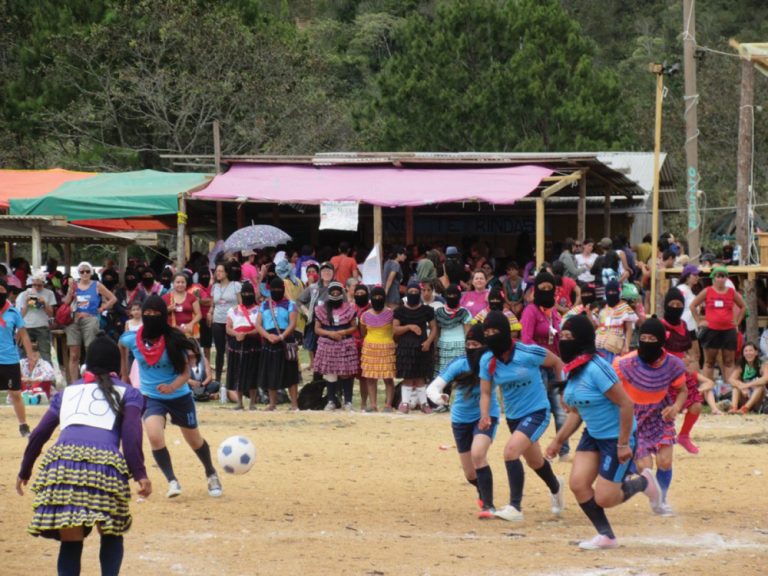 The resistance that constitutes a way of life for women impresses through the sheer diversity of its methods. Among the women who resist not only on the battlefield behind barricades, but across every domain of life, are the Zapatista women who have chosen to assert their existence through football. We all know the stories of the indigenous Zapatista women and their struggle for freedom. But this is perhaps one of the less well-known forms of resistance. Since the 1990s, the Zapatista sisters have taken to the pitch with football as a form of resistance — both against patriarchal traditions and against those who rule. For the women’s football team of the Hermanas Zapatistas, life is a form of resistance against being banished from the streets by patriarchal traditions and war.6 They play not for competition or prizes — they play to share. Sometimes barefoot, sometimes with their children on their backs, they play football and in doing so break the patriarchal rules of the game. The Hermanas Zapatistas are an example of the subtleties of female resistance.7
From Hypatia to Ferhunde: Women’s Resistance for Truth in Philosophy
In antiquity, the insights, works, and manner in which Hypatia of Alexandria questioned the world were an act of resistance in the agora. The female memory preserves knowledge and passes it from generation to generation, as an antidote to the male, patriarchal mentality. But the male mentality responds to this resistance in every age with unchanging attacks. We all know Hypatia’s story more or less, but very few of us know the true story of Ferhunde — because patriarchal power prevents us from seeing the truths behind the veil of mist. The Afghan woman Ferhunde was a philosopher who studied theology. Everyone has read about Ferhunde as the “poor woman who was lynched.” But the truly “poor” were the blind or blinkered ones of that time, because Ferhunde was a resistance fighter who cried out the truth in the streets — against the patriarchal mentality and against everything that people suffered because of it.
Ferhunde began to speak in the streets of Kabul about the contradictions of faith and existence — against the religious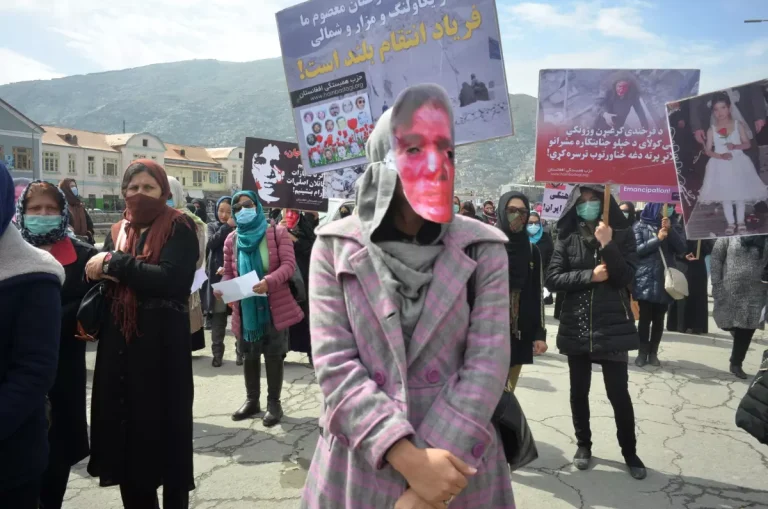 merchants who deceived people with amulets. She confronted the overwhelmingly male crowd gathered around a shrine exploited by these false religious merchants with the truth, saying: “The truth does not lie in this amulet; faith gives you the strength to heal, but it does not heal — that power lies within you.” The religious fraudsters, angered by the situation, summoned Ferhunde and threatened her with words like “Watch what you do…” But she was not intimidated; she resisted and continued to speak what she knew. The alliance of religion, men, and ignorance could not bear a philosopher telling them the truth to their faces. They lynched Ferhunde on 19 March 2015 before the shrine and then burned her. Just as Hypatia, fifteen hundred years earlier in Alexandria, was lynched by religious merchants who could not endure her advancing — with the defiance of a woman — in pursuit of truth in science and philosophy. No matter which corner of this earth one sets foot upon, no matter which culture one touches beyond “official history” — everywhere one encounters similar stories of resistance and the struggle for existence; for this, it suffices merely to look beyond the veil of mist. What has been described above is only a handful of examples — as far as my pen was able to recount — as an expression of respect for all the women who have continued resistance as a form of life and as a tradition for thousands of years.
And Efrîn…
The historical heritage of women’s resistance lives on and will doubtlessly continue to do so, but let us first dwell on the stories of some women from Efrîn who witnessed “epochal resistance” at first hand and whose lives are already history. For the women of Efrîn are among those who teach us, while simultaneously proclaiming both truth and hope. Like their land, their forms of resistance are at once unadorned and marked by great wisdom.
There is, for example, the form of resistance of Rozerin, whom I encountered on a misty spring day in the courtyard of a green, leafy village in Efrîn. Rozerin — without us having had the chance to learn more than her name about her life — went to the front line of the fighting as if going to a festival. She was not from there, but she had clearly fallen in love with a life that found meaning in Efrîn. And with her clear gaze, before going on her final mission, she whispered to all women the legacy of her resistance, as though leaving a testament: “We trusted no one when we began this resistance; we chose it freely — for our land, our identity, and our future. How it ends, we will have to leave to history, but right now I am here and I am fighting for the traces I will leave behind in history. For all women…”
Let us speak of the organisation of women’s self-defence units (HPC/Jin) in every district of this city, where war rages relentlessly and aircraft drop their bombs daily. In Mabeta we met Lamîa Cemal, just as she had rocked her four-year-old child to sleep and entrusted her to her neighbours, while preparing herself to go to the front. In her own words, one must tell what a virtue resistance is: “My child is still very young, but I tell her anyway. I tell her that I am going for our land, for our people. I tell her that I am going to serve our people. Because she is still small, she does not understand much, but one day she will understand that I am doing it for her.”
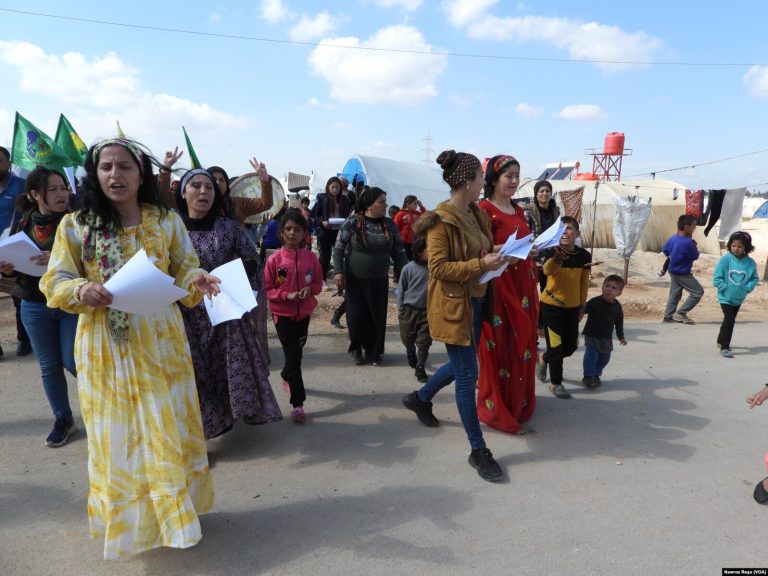 Another front, another place of resistance: Şera. A woman in her fifties, mother of four children, keeps watch at the front: Fatima Mustafa. Even during the days when the Syrian civil war began in Aleppo, she defended her neighbourhood with a weapon in hand and then returned to Efrîn. “We fought hard to make this land our home again; we pitched tents, planted our gardens, built our houses — and now someone is trying to drive us from our homeland. No one should expect us to accept that,” begins Fatima’s account. She shows her hands, bleeding from digging trenches, and continues to tell of her story of living through resistance: “We must defend ourselves, our children, and our homes. We have trained all women between the ages of 40 and 80. The attacks are very brutal. To defend ourselves against these attacks, we arm ourselves. We were also at the front in the battles for Aleppo and Til Rifat. Day and night we defend ourselves, we resist. As far as our strength allows…”
One must also listen to Azime, who transformed the small textile workshop she had run in Cinderes before the occupation attacks began into a hospital for the wounded, where she administers first aid. A small, dark-skinned woman with radiant eyes, who tells of how there is more than one form of resistance. While her two children fight at the front against the occupation, Azime has found another path of resistance for herself. She tends to all the wounded who come to her small hospital with the same care as she would her own children. Azime’s care and her words heal many wounds, and those who recover choose to return immediately to the front and resist the occupation with even greater strength. After dressing the wounds, she leans forward and says: “I know you are in pain, but this wound is sacred. You will recover, for the fertility of our land heals all wounds. You must resist. It is not a wound that kills a person, but hopelessness. As long as we have hope, there is no wound that will not heal…”
These accounts are only small fragments of the stories of thousands of women in Efrîn, and in Azime’s words lies, ultimately, the heritage of resistance. Simple — and equally simple in its wisdom: “As long as there is hope, there is no wound that will not heal.”
Perhaps this is why thousands of women from Efrîn — who resisted the occupation’s attacks with a will rarely found in this world — are now organising life and resistance in Şehba for the return. The form of resistance of these women, who despite the harsh conditions in the camps preserve their hope and their resistance so as not to be separated from their land and from the system of women’s liberation they have built, has taken on a different shape.
In Şehba, another form of resistance begins, and there Doha Îbîş takes the floor. She stands simply by the roadside with her children and the few belongings she was able to carry after losing her loved ones in the resistance against the occupation in the district of Raco in Efrîn. She tells of how she lost her husband in Efrîn while defending against the occupation’s attacks. “When Turkish warplanes hit my husband, I went to the hospital. He was completely burned, only the bones remained. I placed my hand on his chest — it was very hot. Before, I used to be always cold, but since that day my heart is like a fire and I am cold no more…” she says, as she waits by the roadside in the March chill.
“I made a promise,” she says, waiting for the day she can return to her homeland. “I made a promise — to myself, to my children, to those I have lost. Until that day comes, we remain here…”
Yes — Maryam, Khanum, Constance, Hypatia, Ferhunde, the Zapatista sisters, Zilan, Fatima, Azime, Doha… Only a few stories from a legacy stretching across millennia, which has condensed in the past century. All these endless names and stories are forms and expressions of resistance. Every resistance leaves a legacy; sometimes what is gained over time is lost in a single moment, and yet they inevitably find their meaning and their place in yesterday, today, and tomorrow. With simple, plain, and comprehensible stories, they teach us the form of existence and the method that the present age seeks to devour — namely, resistance…
Bibliography:
Alev Aslan, “Woman” in the Back Room of History, Ankara Üniversitesi İlef Dergisi 2 (2015): 77–94
Armenian National Archive, Kedername: Armenian Genocide in the Ottoman Empire 1915, trans. Diran Lokmagözyan, Belge Yay., 2014
Fatmagül Berktay, The Gender of History, Metis Yay., 2003
http://meydangazetesi.org/gundem/2013/03/dunyanin-bir-ucundan-diger-ucuna-direnen-kadinlar-ozgurlesiyor/
http://www.historylearningsite.co.uk/ireland-1845-to-1922/countess-markievicz/
https://www.chiapasparalelo.com/noticias/chiapas/2018/03/clausuran-el-encuentro-mujeres-que-luchan-convocado-por-zapatistas/
Serpil Çakır, Ways of Accessing Women’s Experiences in Historiography, Kadınların Belleği Bülteni 36 (2004)
1 Fatmagül Berktay, The Gender of History, 2010, Istanbul, Metis Yayınları: 28
2 Serpil Çakır, Ways of Accessing Women’s Experiences in Historiography, Kadınların Belleği Bülteni 36 (2004)
3 Alev Aslan, “Woman” in the Back Room of History, Ankara Üniversitesi İlef Dergisi 2 (2015): 77–94
4 Armenian National Archive, Kedername: Armenian Genocide in the Ottoman Empire 1915, trans. Diran Lokmagözyan, Belge Yay., 2014
5 http://www.historylearningsite.co.uk/ireland-1845-to-1922/countess-markievicz/
6 https://www.chiapasparalelo.com/noticias/chiapas/2018/03/clausuran-el-encuentro-mujeres-que-luchan-convocado-por-zapatistas/
7 http://meydangazetesi.org/gundem/2013/03/dunyanin-bir-ucundan-diger-ucuna-direnen-kadinlar-ozgurlesiyor/