
From Medusa to Rojava: The State That Fears Braided Hair
Esra Bilen (Jin Dergi)
Don’t we have enough reasons to wrap ourselves in all the tones of revolt, to interweave ourselves and anchor ourselves in rebellious resistance?*
Camisha L. Jones
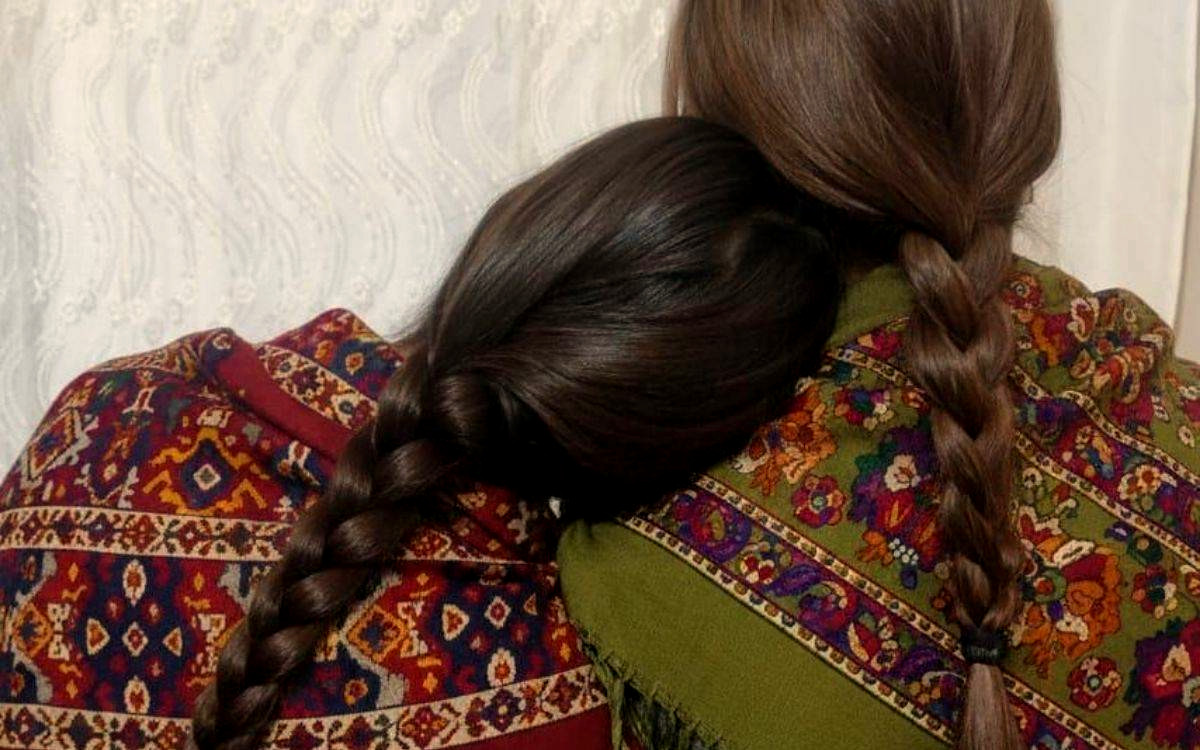
In recent weeks, a video has been circulating of a man connected to jihadists in Syria. In it, he presented the cut hair of a killed female fighter like a war trophy on social media. With a mocking tone, the man displayed the hair and suggested that “only this” remained of the woman. After these images were spread, women in various places around the world began posting short videos in which they braid their hair.
At a time when the renewed recognition of Kurds on the basis of equal citizenship is being debated, one would have expected that the law – instead of functioning as a cudgel against Kurds for 100 years – would identify the perpetrator of the war crime according to universal standards. Instead, investigations were initiated against women who shared videos of themselves braiding their hair. Arrests followed, house searches, judicial obligations, and suspensions of public sector employees. In contrast, there is not a single actually confirmed report of proceedings against the person who displayed the braided hair as booty and made this humiliation public. The 100-year history repeats itself – someone who degrades Kurds and their values remains invisible. The women who resisted with civil disobedience are punished. This situation is not a legal conflict, but a decision. The women see through this decision and continue to grow their civil disobedience.
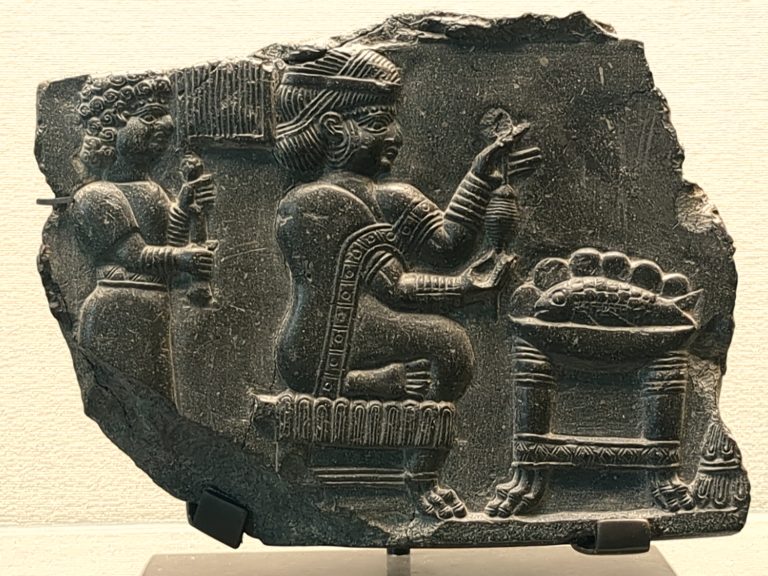 In mythology, symbols such as ropes, knots, braids, and weaving are considered ritual principles of order that counteract the disintegration of the world. In the face of chaos, disintegration, or death, there is not the law, but the ritual. The ritual does not command, it repeats itself – and in this ritual the world exists only as long as it is connected. That the braided hair of a female fighter is cut off and presented as a trophy is therefore not an arbitrary cruelty. It is, in a mythological sense, an act of destroying order; the declaration that the woman’s connection to the world has been severed. The braiding of hair by other women can be understood as a counter-ritual – it means restoring the connection violently separated by the cutting of hair. Can hair braiding actually be used as evidence of a crime? The short answer is, no. The long answer is, it is not only completely nonsensical to connect hair braiding, one of humanity’s oldest rituals, with a “terrorist organization,” but there is also no legal explanation for the claim that such an action triggers feelings of hatred in people that could lead to violence.
On the contrary, these actions are a peaceful form of protest against the aggression that jihadist gangs 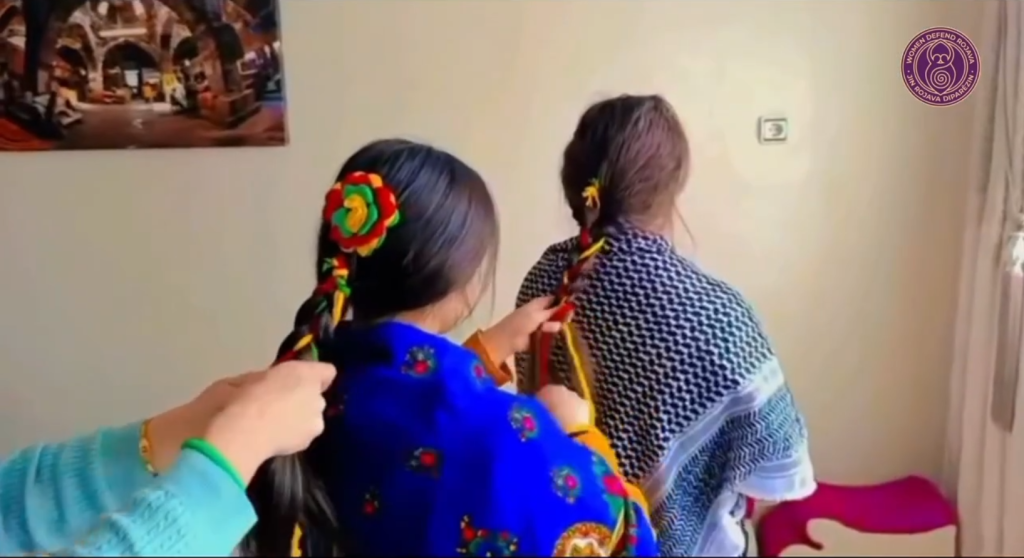 show toward Kurdish women. It is therefore out of the question that braiding hair constitutes a crime and falls under the right to freedom of expression. For women who braid their hair to be charged with propaganda for a “terrorist organization,” their form of expression would have to stir up blind hatred that incites people to violence. But one must note that the acts of violent gangs that throw the bodies of female fighters from unfinished buildings, or tear out the hearts of imprisoned Kurdish youth, are not considered crimes, but the hair braiding of women is. That the state attempts to define this practice as “propaganda” does not stem from a legal provision, but from a historical fear triggered by the symbolic braiding of hair. This fear is not a temporary protective reflex. It is a traumatic memory that has embedded itself in male-dominant state thinking, and been passed down through generations.
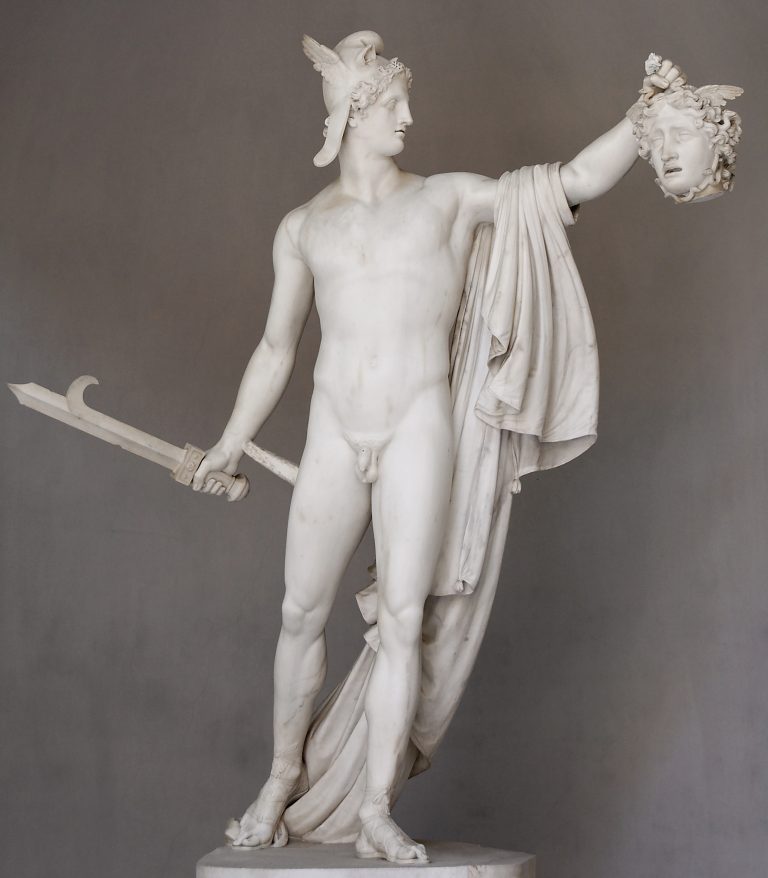 Mythology reveals this memory very early. The narrative of Medusa is one of the clearest examples. The story of Medusa is not a mere monster tale subsequently inserted into the Greek pantheon. One can also read Medusa’s story as an attempt to suppress a “woman of the mountains” (with roots going back to the Medes and Persians). Medusa in this reading is not a Gorgon, but a princess with Medo-Persian roots, a woman from the mountains. When the male divine order cannot deal with this figure, she is first excluded from the center, then imprisoned in the temple, and finally punished through her body. That is, Medusa is first held captive in a temple that stands at the center of the male-dominated sacred order, and there is attacked by a god. Although the attack is directed against her, justice is turned on its head and Medusa’s body is punished by her hair braids transforming into snakes. The curse thus manifests itself in her hair.
Braiding is an expression of women’s connection to the world, their memory and their permanence, and precisely for this reason the braided plait is coded as a threat. The ancient connection to life, to the earth, and to the underworld, is branded as “monstrous.”
Patriarchal power cannot deal with the disobedient woman, and tries to denigrate and demonize her to remove her from circulation. That Medusa, after the assault by a god, meets not justice but damnation, reveals the founding trauma of male supremacy – the patriarchy can govern the female body and will, which it cannot control on a mental level, only through demonization.
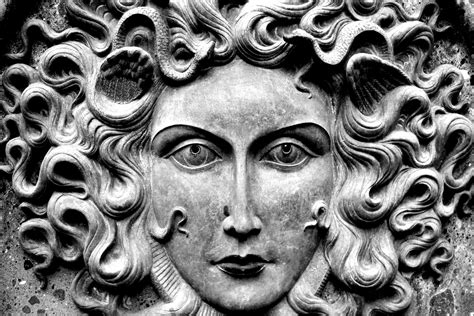
Today’s criminalization of braids is a contemporary expression of this ancient fear of the male-dominant state. The state here is not fighting a crime, but trying to make invisible again something it has not historically come to terms with, because the reaction of women to braid their hair is a movement that reverses Medusa’s curse. The rejection of the attribution of monstrosity means continuing to create meaning from what is supposed to inspire fear. Therefore, today’s events are not temporary repression, but signs of a greater rupture.
While the sacred state fights against braided hair, and in order to demonstrate its “power” arrests women who braid their hair, the women simply continue with this action. This is because they are reclaiming the right to create meaning, and is not a reflex of a society through spectacle or pure symbolic politics. It is a way of not bowing to humiliation, and insisting on keeping memory alive. When the law is abused to stifle this determination, it weakens the law – the ritual, however, becomes stronger. All the women who are to be punished today know this. Therefore, this action will continue to grow, because although women’s physical and ritual actions have been repeatedly banned and sanctioned throughout history, they never disappeared. On the contrary, they spread into spaces that power cannot penetrate.
That the braiding of hair is so targeted is therefore not a question of public security, but shows a crisis of legitimacy. The state here is not preventing a crime, but admitting that it has lost control over meaning. Interestingly, even bloodthirsty murdering gangs cannot frighten the sacred state as much as millions of women braiding their hair. The logic seems to be “They may be our neighbors, but please, no women braiding hair in our vicinity.” This reflex is not foreign to women from history, because already during witch hunts, guilt was not sought in the act, but in the body. Today, a similar logic operates – the real problem is not the braiding of hair itself, but that others can do it too. Repeatability has always been a threat to power. Although history also shows that women’s struggle does not disappear when it is suppressed, but spreads to other areas. With this ritual, thousands of women connect to the meaning and life of the fighter whose hair was cut off, and will continue to do so.

*From the poem “My Hair Starts the Revolution” by Camisha L. Jones.
The article originally appeared in Turkish, see: https://jindergi.com/yazi/medusadan-rojavaya-sac-orgusunden-korkan-devlet/