
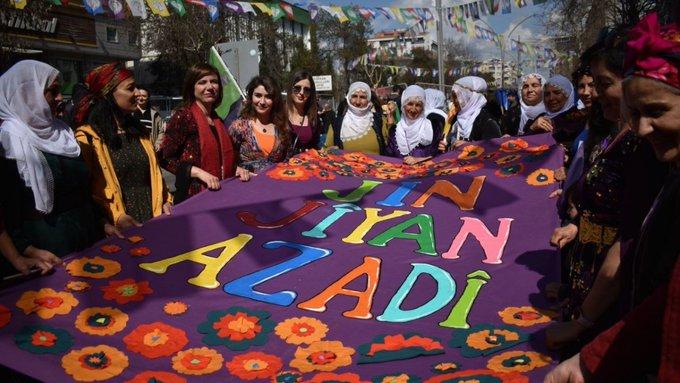
Women’s Liberation Struggle and Democratic Society in Negotiation and Peace Processes
Jineolojî Academy
With Rêber Apo’s historic call for Peace and Democratic Society, the analysis of the experiences of the Kurdistan Women’s Liberation Movement and women’s efforts in peace and solution processes in different countries gains importance. Peace processes that continue armed struggles initiated by liberation movements have their own historical, cultural and political realities in each country. Differences become evident both in social and economic conditions, policies of local and hegemonic forces, as well as in ideological aspects, the level of organization and policies of liberation movements. There is no recipe that can be passed directly from one country to another. However, analyzing the achievements and mistakes of women’s and movements’ experiences in different parts of the world is important for clarifying the politics of the Kurdistan Women’s Liberation Movement in this historic process.
Since World War I, women from various countries and different movements, as peace activists, have developed important efforts to change the man-state, racist and exploitative power system. The International Conference of Socialist Women in Bern and the International Congress of Women for Peace in The Hague in 1915, with the participation of 1,136 women from 12 countries, are examples of this. With the vanguard of the Socialist Women’s Conference, international support from women and workers was revitalized against nationalism, militarism, capitalism and imperialist war. This attitude was the basis of the Soviet Revolution and the uprisings of soldiers and workers that stopped World War I. “War has been made by the hands of men, and it must be stopped by the hands of women” expresses the mentality of the Congress held in The Hague, and was also the title of the manifesto written by the Armenian delegate of the Congress, Lucy Thoumaian. The decisions and work of the delegates of The Hague Congress regarding a permanent international tribunal to judge war crimes, the definition of group violations as a tool and a war crime, the prohibition of the arms trade, the creation of a new world economic system and the construction of the Women’s International League for Peace and Freedom (WILPF) were pioneering works for the creation of the League of Nations (predecessor organization to the UN) and for international law.
Negotiation Processes and Peace Treaties
Despite women having leadership in solution and peace processes both internationally and with their work and social relations, generally they and their proposals were left out of negotiation mechanisms and peace treaties. In the 1990s, with the impact of war and massacres in Yugoslavia and Rwanda, feminist and pacifist women organized international campaigns to judge rapes and sexual violence as war crimes. As a result of women’s struggle, the UN Security Council accepted in 2000 Resolution 1325 to stop and judge sexist violence in wartime, and to include women’s participation in peace processes. But UN data shows that women have only actively participated in 6% of peace treaties signed between 1992 and 2019. Research reveals that dialogue and peace processes in which women’s will and perspective are not present fail, and do not build permanent social peace. The possibility of implementation of peace treaties in which women participate increases by 35%. But the important thing is that women’s participation should not be symbolic or elitist. Most importantly, women from all social sectors should be able to participate in discussion processes and, through representatives of women’s movements, their will and desires should be effectively taken into account in peace agreements.
The dominant method of peace processes has been created as an elitist policy based on five phases:
-
Negotiations between representatives of the parties in conflict. Usually with the participation of neutral observers or intermediaries.
-
Agreements and signatures of peace treaties.
-
Cessation of military confrontations.
-
“Return to normal situation” (disarmament and dispersion of non-state armed forces and implementation of reforms by the state).
-
Reintegration of ex-combatants into the state system, society and family.
Many of the peace processes carried out with this conception have failed. The 1993 Oslo Accords between Israel and the Palestine Liberation Organization (PLO) or the 1993 Arusha Accords to end Rwanda’s civil war are examples of this. Just as the greatest massacres were carried out after the signing of these peace treaties in Palestine and Rwanda, after three years of the failure of the 2006 Oslo process, the state of Sri Lanka executed the greatest massacres against the civilian population and cadres of the Liberation Tigers of Tamil Eelam (LTTE) in Tamil Eelam. These examples show how, both in situations of failure of peace talks and after the signing of peace treaties, the greatest dangers of massacre continue to exist. The process that led to the signing of the peace treaty between FARC guerrillas and the Colombian state in 2016 was also generally carried out within the framework of the five phases mentioned. But the force of capital and large landowners blocked land reforms, and hundreds of ex-guerrillas were massacred by state forces.
In many countries where war officially stops after peace treaties, violence takes different forms. For example, women from countries in Abya Yala, Africa and Asia explain that after the end of armed wars, sexist violence and massacres against women increased. Women who had been guerrillas face pressures from the state, marriage and family. In processes defined as “return to normal situation” or “reintegration,” the man-state system primarily tries to defend its sovereignty and introduce women and revolutionaries into patriarchal status. Through state institutions, religion, education and media, social sexism and rape culture are intensified. After peace treaties, women’s dignity, as happened with FARC women, is often trampled with labels like “prostitute” or “commanders’ women.” Furthermore, after processes of war and massacre in places like Sierra Leone, Nepal, Bosnia, Sri Lanka and many other countries, women have been defined only as passive victims, ignoring their effort and struggles for justice and peace.
The Sandinista women who commanded war fronts during the Nicaraguan revolution explain that after the military triumph of the revolution in 1979, they were left out of decision-making mechanisms. The new rulers, like Daniel Ortega, tried to limit women’s role again to wife or mother and use them for their personal interests. Instead of a democratic system that defended the rights of workers and indigenous peoples, an autocratic system was imposed again. Therefore, the struggle of these women against power continues to this day within different organizations.
Rêber Apo, in the defense Sociology of Freedom, defines peace as “an agreement between democracy and the state.” Based on the fact that “In peace there are parties. There is not and should not exist one hundred percent domination by one of the parties,” he expresses these three conditions for the realization of peace: The first condition for peace is that everyone can live with security. This is only possible with self-defense and with the moral and political character of societies. Second, it is not possible for one party to be dominant. “Whatever party it may be (right or wrong) if both parties accept the cessation of war without imposing themselves (with weapons), then peace can enter the agenda.” Third, all parties will respect the work and democratic structures of society in addressing the problems underlying the conflict. (…) In that situation, democratic politics plays a vital role. Only dialogue between democratic forces can confront the power and forces of the State and achieve a meaningful peace process. Without that peace, even if the warring parties silence the weapons for a while, the state of war will continue. The silencing of weapons in this context cannot be considered peace, but rather a ceasefire that is a harbinger of a fiercer war to come. For a ceasefire to lead to authentic peace, the three conditions described must be met.
Women’s movements and peace activists have pointed out in recent years that peace does not only mean the cessation of military conflicts. Peace is defined as a dynamic process that encompasses efforts to guarantee democracy, social justice, equal rights for women and all cultural and social identities.
Truth and Justice Commissions
Without truth and justice seeking processes that embrace women and all social sectors within themselves, and without solving the reasons for conflict and war, the advancement of a common democratic and peaceful life is not possible. In this way injustice and inequalities continue and become a source of new wars and conflicts. One of the most important and transformative methods in peace building is the collective search for truth and justice. Revealing the truth, confronting war crimes and their criminals, forgiveness and accountability, all are indispensable for building social memory, renewing social consciousness and achieving lasting peace. In this framework, alternative historical research and the construction of truth and justice commissions are areas of action for political and moral societies.
According to United Nations data, by 2015, 34 truth commissions had been created in conflict regions around the world. But especially in war, women’s truth and the systematic level of sexual violence are still hidden. In Nepal, Sri Lanka and many other countries, all members of the Truth Commission and commissions responsible for investigating human rights violations have been appointed by governments, thus obstructing women’s participation and possibilities for reaching the truth.
Although in Colombia, as a result of women’s struggle, five women and five men formed the national truth commission, women could not achieve the results they expected. Cases affecting women did not have sufficient follow-up and evaluation. Only after women’s education campaigns could they begin to name their sufferings and all forms of violence suffered, such as kidnapping, torture and sexual violence. But Colombian women activists criticize that personal cases of sexual violence within FARC are equated, in official accounts and media, with the state’s systematized sexual violence crimes.
South Africa’s Truth and Reconciliation Commission, created in 1995, encompassed tasks of investigation, law and forgiveness. This form was used as a model for commissions in other countries. After 46 years of apartheid and centuries of brutal colonialism, it was very hard to face the truth. In this process the concepts of “reconciliation” and “transformative justice” were developed, and women participated actively. The South African Women’s Movement closely followed the solution process and tried to solve the commission’s errors. Black women had deep historical and political knowledge; they had also suffered torture and severe trauma. But women’s applications to the truth commission, formed by men, were scarce. Women activists denounced this and did not accept men’s preeminence in the commission, nor that men should listen to women. As a result of this struggle, autonomous women’s commissions were created for women’s cases and sexual violence. In this way women’s participation level reached 56%. But most women were left out of the compensation process, because only victims of racism and torture from the apartheid system were compensated. Victims of social violence and exploitation could not be compensated. Today the struggle of South African women continues for peace and against rape culture and the massacre of women.
In the experiences of 34 countries it can be seen that in most of them women did not participate as subjects in the commissions, and only through the struggle of women’s movements could they achieve their participation, but when women occupied their place in official commissions, the commissions’ work was limited to methods of rehabilitation, psychological and legal support. Sufficient justice mechanisms were not created to judge crimes against women. Likewise, there was scarce presence in defining gender violence prevention policies. Therefore, women’s movements and structures in countries like Nepal, Colombia and the Philippines carried out social justice work; in all regions they organized meetings called “peace tables for women.” In this way tens of thousands of women could share their experiences and jointly debate their opinions to achieve justice and peace. The documentation of thousands of women’s statements in a safe and reliable way becomes important data for evaluating and writing the historical truth of women’s struggle. At the same time women can, with this method, determine their policies and strengthen their social organization. The commitment of mothers to find disappeared persons pressures delegates to reveal the truth. The Mothers of Plaza de Mayo in Argentina, the Saturday Mothers in Turkey and Kurdistan, or the Mothers of Soacha in Colombia, “those who knew the truth,” with their long actions have become important activists of social consciousness and the impact of democratic politics.
The Need for Continuous Social Struggle
Women’s struggle to achieve peace, democracy and freedom is a continuous, social and political struggle. For the triumph of this struggle, autonomous organization of women and a common attitude are always necessary. Generally, to reach a solution and peace with state forces, in the realm of women’s struggle diplomacy, three phases can be seen:
-
Struggle to reach negotiation processes and guarantee the representation of women’s collective will in debate processes, commissions and decision-making mechanisms.
-
Struggle to establish the demands of liberation and women’s movements in peace agreements, decisions and laws.
-
Struggle for the implementation of the content and principles signed in peace agreements, as well as the institutions and laws related to them.
Undoubtedly, in all phases the social, ideological, political and activist organization of women’s movements is determining. Women have played leadership roles in preparing peace processes, with actions for justice and peace, in which women from both oppressed and dominant nations and religions have often participated. Joint initiatives by Catholic and Protestant women in Northern Ireland, the foundation of initiatives and networks like “women in black” in 1988 against Israel’s occupation war, or in 1991 by women of all peoples of Yugoslavia against war and racism, the actions of Russian mothers against the war in Chechnya, or the Peace Mothers in Turkey and Kurdistan are some examples.
By sharing pain and women’s understanding that in war all sectors of society suffer great losses, racist, nationalist and religious fundamentalist war propaganda was exposed. The beginnings of dialogue and negotiation processes have given hope and energy to social movements and actions. In this way, in these processes women’s political, social and cultural action has been strengthened. Women wanted to raise their voice and color for peace and a free future.
The experiences of different countries show that although women have had difficulty validating their will in phases 1 and 2, it is especially in phase 3 where difficulties arise. Because in these processes state forces and capitalist modernity have applied new special war policies to destroy and damage societies. For example, in Abya Yala countries the violence of cartels, prostitution gangs, and trafficking of women and children has reached the highest level. The land and nature of areas that were previously under protection of guerrilla forces are now being destroyed and plundered by international companies. Furthermore, when contradictions between man-state forces decrease, often pressure on women increases. For example, in negotiation processes between Iran and the USA, attacks and executions against women increased.
Especially in the reality of the Third World War it has become evident that international law, UN institutions and traditional methods for achieving peace and justice have failed. The state and hegemonic capitalist forces direct multiple wars and massacres against societies. Peace meetings and agreements are also used as a war tactic with the objective of destroying their adversaries. The shock doctrine policy is in force. Dictators like Trump, Putin and Netanyahu change their words and decisions daily, according to their interests, violate international agreements and impose war and massacre against peoples.
Peace researchers, like the president of the Inclusive Peace association in Geneva, Thania Paffenholz, point out that the linear peace paradigm and international security system have failed. Therefore, simply integrating women within a failed system is not enough. It is necessary that women can be an organized vanguard force for building a system and democratic mentality of society.
Rêber Apo also emphasizes this reality in his perspective and work for implementing the call for Peace and Democratic Society. The experiences of women and peoples of the world also show that state forces will never be founders or guarantors of peace. The triumph of peace and the solution to women’s and society’s problems can only be realized by democratic society with the vanguard of the women’s movement. In this way democratic society can be defined both as organizer and method, as well as objective and guarantee of peace processes.
Experience of the Kurdistan Women’s Liberation Movement
It has been 32 years that Rêber Apo, with his initiatives and efforts to reach a political solution and peace in Kurdistan and the Middle East, has given a strategic role to the women’s liberation struggle. In 1993 Rêber Apo proclaimed, in his declaration of the first ceasefire, the women’s army as the basis for solving social, political, philosophical and peace problems. In 1995, on one hand, YAJK was founded as the Kurdistan women’s liberation movement in the military, social and political field, and on the other hand the second ceasefire was declared. In 1998 Rêber Apo announced the Women’s Liberation Ideology and established the basis of the women’s party and, in turn, declared the third ceasefire. Especially in the Imrali period, Rêber Apo has extensively analyzed the leadership tasks of the Women’s Liberation Movement in all fields of life and struggle, with his perspectives on the strategic change of the Kurdish Movement based on the paradigm of democratic, ecological and women’s liberation society.
The tasks that Rêber Apo defined in a meeting in 2002: writing women’s history, implementing the women’s revolution and elaborating women’s social contract, encompass intellectual, political and moral tasks. Rêber Apo, with projects like creating freedom houses for women, free women’s associations of the world, cooperatives, parks and women’s cities, showed us the steps to weave the women’s confederal system. In this way, Rêber Apo gave a leadership mission to the Women’s Liberation Movement in building the democratic autonomy system, based on women’s self-defense and the development of society’s democratic politics, as well as building communal economy, education and social justice.
Rêber Apo has constantly created new agendas for change and democratic transformation of men’s mentality, and to end the culture of rape and massacres of women, society and nature. Likewise, Jineolojî and the concept of free coexistence have become roadmaps for deepening and obtaining results from the women’s liberation struggle as the basis of democratic society, which is the strategy and objective of our struggle.
On the other hand, Rêber Apo, with the formula of “state + democracy” has struggled to achieve democratic changes in state mentality and institutions, trying to break policies of denial and extermination against the Kurdish people. To open the path to democratic solution and peace beneficial to all parties, Rêber Apo has developed calls and roadmaps, as well as dialogues with state delegates. At the same time, Rêber Apo has focused on putting women’s rights and freedom principles on the agenda, developing the co-presidency system and equal representation of women in political and diplomatic work.
If we make an evaluation of the results of 32 years of Rêber Apo’s work and struggle for peace and democratic society, we see that, together with his campaigns for peace, the sociality of the women’s liberation movement also advanced, alongside women’s support and organizational attitudes in legal politics and creating democratic autonomy.
In the 1990s, when the war in Turkey was at its hardest moment, the Women’s Liberation Movement and human rights defenders led the organization of a peace movement. Initiatives and campaigns such as Don’t Touch My Comrade (1993), Saturday Mothers (1995), Peace Mothers (1996), Women’s Meetings for Peace (2004), and The Time for Peace Has Come (2005), which had influence in these processes, are examples of this struggle. Especially the Peace Mothers initiative, founded by Kurdish mothers and the Saturday Mothers, who continue their actions to find the disappeared and for justice in Turkey, are important actors in social politics. The Women’s Initiative for Peace (BÎKG) from 2009 to the present organizes women’s actions in regions of western Turkey and defines women’s struggle for peace as a strategic social, ideological and political struggle.
These different organizations created around the struggle for peace continue their actions of raising society’s awareness and developing support between peoples with methods like street protests, rallies, demonstrations, meetings and signature collection campaigns.
In the peace interviews that began in 2013 in Imrali, in 2015, for the first time, a direct representative of the Women’s Movement participated in the HDP (People’s Democratic Party) delegation. With the objective of sharing women’s agenda and reaching society’s desires, through the women’s movement representative at the dialogue table, the Women’s Freedom Council (KÖM) was founded. KÖM, as a joint council of Kurdish women, women activists and feminists from western Turkey, should have developed the women’s liberation perspective for the official peace dialogue process. But that same year the state directly abandoned the dialogues in Imrali, and subsequently war started again. In that process, the State’s harsh pressures were the main obstacle to women’s struggle for peace. With the failure of the dialogue table and non-recognition of women’s will, the state increased war, nationalism and sexism again.
The women of Turkey and Kurdistan, gathered under the umbrella of BÎKG to guarantee women’s active participation in the peace process, researched women’s experiences in the world and valued as reference examples of women’s role in social reconciliation. With the slogan “If peace is made without women, war will not end” they developed preparations to guarantee equal representation of women in the dialogue process. They planned to meet with all linked parties to collect and put on the agenda the opinions and proposals of all social sectors for just and true peace. They especially worked to change laws that ignore women’s needs and desires.
With this objective, five commissions were created within BÎKG:
-
Women’s Truth Commission to bring to light war crimes against women.
-
Gender Equality and Constitution Commission to debate law changes to guarantee gender equality and compensation for war crimes against women.
-
Security Reform Commission to determine human security protocols to prevent war crimes against women.
-
Press and Media Commission to put women’s opinions and demands for peace on the agenda.
-
Relations and Observation Commission for active monitoring of the solution process, evaluation of the process from women’s perspective, holding meetings with all social groups, especially with women’s groups and all parties to determine joint expectations and opinions of women for lasting peace.
When the dialogue process transformed into negotiation, it became necessary for women to participate at the negotiation table with their concrete demands and organize within this framework. Therefore, the Women’s Liberation Movement was reorganized in 2014 under the name Congress of Women’s Liberation (KJA). Subcommissions were created to clarify women’s needs and demands in all areas of life to create the structure of a new social contract. From economic issues to diplomacy, from ecology to law, from politics to self-defense, commissions were created and preparatory work was carried out. The HDP delegation was first composed of one woman and two men. For a long time the state did not allow the Women’s Liberation Movement representative to participate in the delegation. But in the negotiation process Rêber Apo defended the representation of the women’s movement as a principle and waged a great struggle for it to be so. In the negotiation process the delegation was formed by two women and three men. The participation of a member of the Women’s Liberation Movement coordination for direct representation of women’s will and demands was an important step.
Likewise, women prepared their roadmap for the peace and democracy process, based on four principles:
Correct definition: The women’s problem must be correctly defined. The women’s problem is not only a gender problem. It is an ancient problem in the Middle East. It is one of the main social, political, economic and moral problems. The reasons for the emergence of the women’s freedom problem at the same time evidence its method of solution.
Legal expression: In the current constitution neither women’s existence, identity and rights, nor the women’s freedom problem and its solution methods, are defined. In some parts and different laws women’s names appear mainly as victims. Again, family and civil laws mainly seek to justify the family. It is necessary to define and solve these issues based on women’s liberation.
Equal and organized participation in the confederal system: Evaluation and clarification of the entire women’s system and with it women’s place and participation in the confederal system is necessary. It is important that women determine their equal and organized participation, from participation in democratic politics to self-defense, self-organization and other areas of life.
Equality and freedom in the family: Issues such as reorganization of relations between women and men; laws and perspectives on marriage; divorce; women’s will and rights in reproduction and child-rearing; definition of domestic work and women’s leadership role in it; fair distribution of property; attitudes in education and many others must be restructured with the participation of women’s will and ideas.
In the current process it is important to renew these principles and revitalize the work of the five commissions. It is also important to share experiences and have debates between women about negotiation and solution processes in Bakur/Turkey and in Rojava/Syria.
In the process between 2013 and 2015 the Women’s Liberation Movement in Rojava played an important role in building the Democratic Nation and Democratic Autonomy system, in the defense war of the revolution against attacks by Al Nusra and Daesh as well as in politics and diplomacy. On one hand women created their organization and system; for example, the Women’s Council of North and East Syria was founded as a mechanism for women’s common decisions and will. The Women’s Council of Syria has also worked, with women of all peoples, for peace and democratic changes in Syria; for a new democratic constitution. Likewise, women’s conferences and work have given strength to women’s voice and color in struggles for peace, democracy and freedom, both for Kurdish women’s unity and for building Middle Eastern women’s solidarity networks. On the other hand, women have struggled for implementing the co-presidency system and equal representation of women in all fields of life, as well as in all structures and decision-making mechanisms in democratic autonomous administration areas. Women have occupied an important place equally in legislation work and social contract. With popular work and education to change dominant mentality, women have achieved important accomplishments. But there continue to be deficiencies in achieving developed democratic society with the participation and will of all sectors of society, based on direct democracy, communal economy, social justice, ecology and women’s liberation. The origin of these deficiencies is, first of all, shortcomings in building mentality, personality and life based on the paradigm of democratic, ecological and women’s liberation society. On one hand, the Turkish state and AKP government have always increased their extermination attacks on the Kurdish people and Liberation Movement in dialogue processes. But on the other hand the delay and narrowness in understanding and implementing Rêber Apo’s perspectives by democratic political forces has caused the political solution and peace opportunities in the Imrali processes carried out by Rêber Apo to not obtain results.
Tasks of the Peace and Democratic Society Process
Rêber Apo, since 1993, with all the steps taken for peace and democratic solution, has developed new stages for strengthening women’s organization and struggle based on deepening the women’s freedom mentality. The same situation is also valid for the process initiated with Rêber Apo’s call for “Peace and Democratic Society” on February 27, 2025. Women’s liberation ideology, woman-life-freedom philosophy, Jineolojî concept and theory have carried out the third line of women. This line expresses life and freedom against, on the one hand, the postmodern-liberal line that empties women’s identity of meaning and questions even their biological existence and, on the other hand, the conservative-fascist line that imposes women’s existence and identity as slaves of men. Since the visit on October 23, 2024, Rêber Apo, in his evaluations and especially in his message to the Jineolojî Academy, has given great importance to analyses of women’s history, culture and liberation and has expressed his confidence in the leadership strength of the women’s movement for the advancement of the peace and democratic society process.
The experiences of the process of the last 15 years show the importance of creating balances and conjunction of ideological, political and social work. Autonomous mechanisms and organizations of women and society in general must be used based on direct democracy, with the participation of social will. Likewise, with an attractive method all social sectors and different political circles can be convinced to participate in the process. Women’s participation in the political field must be supported by the organized strength of women’s social movement. With the certainty that “women’s freedom is the basis of all freedoms” one must be alert against attitudes that say “now is not the time for the women’s question.” One of the important points on this process’s agenda must be the development of legal, political and self-defense measures for women against social sexism and extermination attacks.
For women to correctly carry out their political, moral and intellectual tasks in this process, it is important that their life and struggle experiences be analyzed jointly and a women’s roadmap be determined. Regarding social politics it is also important that women from all social sectors participate, both in debate processes and in decision-making. Agreements regarding women’s principles, strategy and politics must be supported by women’s will and common stance in society. If this is not done there will be the danger of establishing a new elitist politics. Work like women’s congresses and conferences to clarify women’s collective will and common decisions has important significance. When all participants see themselves as responsible for monitoring and implementing the decisions made in these conferences in their respective fields, women can carry out effective politics for change and democratic transformation. Furthermore, sharing the debates, advances and obstacles of the process with movements and women activists from other countries can create important synergy of internationalist support.
In the field of current intellectual tasks one of the main works is education work for developing democratic mentality. Democratic society and free life are only possible by overcoming conceptions of power and reaching free individual and social will. Therefore it is important that research methods and topics be determined in relation to the objective of solving women’s and society’s problems, and more popular education be organized. For example, research and debates to give answers to the following questions have strategic historical and current significance: What is the meaning of mother goddess culture in women’s personality and in social ceremonies? What are the characteristics of historical society around woman-mother and what is the meaning of these characteristics for implementing current democratic society? How and when did the system of man’s domination, war and state develop? What have been the damages to women and society as a result of patriarchal cultures, like palace culture, Sati culture and rape culture? What is free women’s culture and how does it develop? How can men and women belong to themselves? How to carry out communal socialist life, democratic family relations and free coexistence?
The search for real answers to these questions will be determining for the process’s triumph. Because the construction of peace and democratic society is only possible with changing the dominant paradigm in politics, science and life. A free life can only advance with analysis and elimination of the reasons for war and conflict, with dignity and tranquility. If not, a new dictator will occupy the place of the previous one. Women’s experiences in many countries of the world show the need for elemental changes in mentality – political, economic and social – to close the path to repetition of war and massacre. The history of the Kurdistan Women’s Liberation Movement becomes an example that in the most critical moments women can generate the necessary strength and energy for historical change with communion of thought, spirit and struggle.
References:
[1] Thania Paffenholz: We are in the year 2021. Why are women still excluded from peace processes? May 16, 2021, https://rosalux-geneva.org/de/wir-sind-im-jahr-2021-warum-sind-frauen-bei-friedensprozessen-immer-noch-ausgeschlossen/