
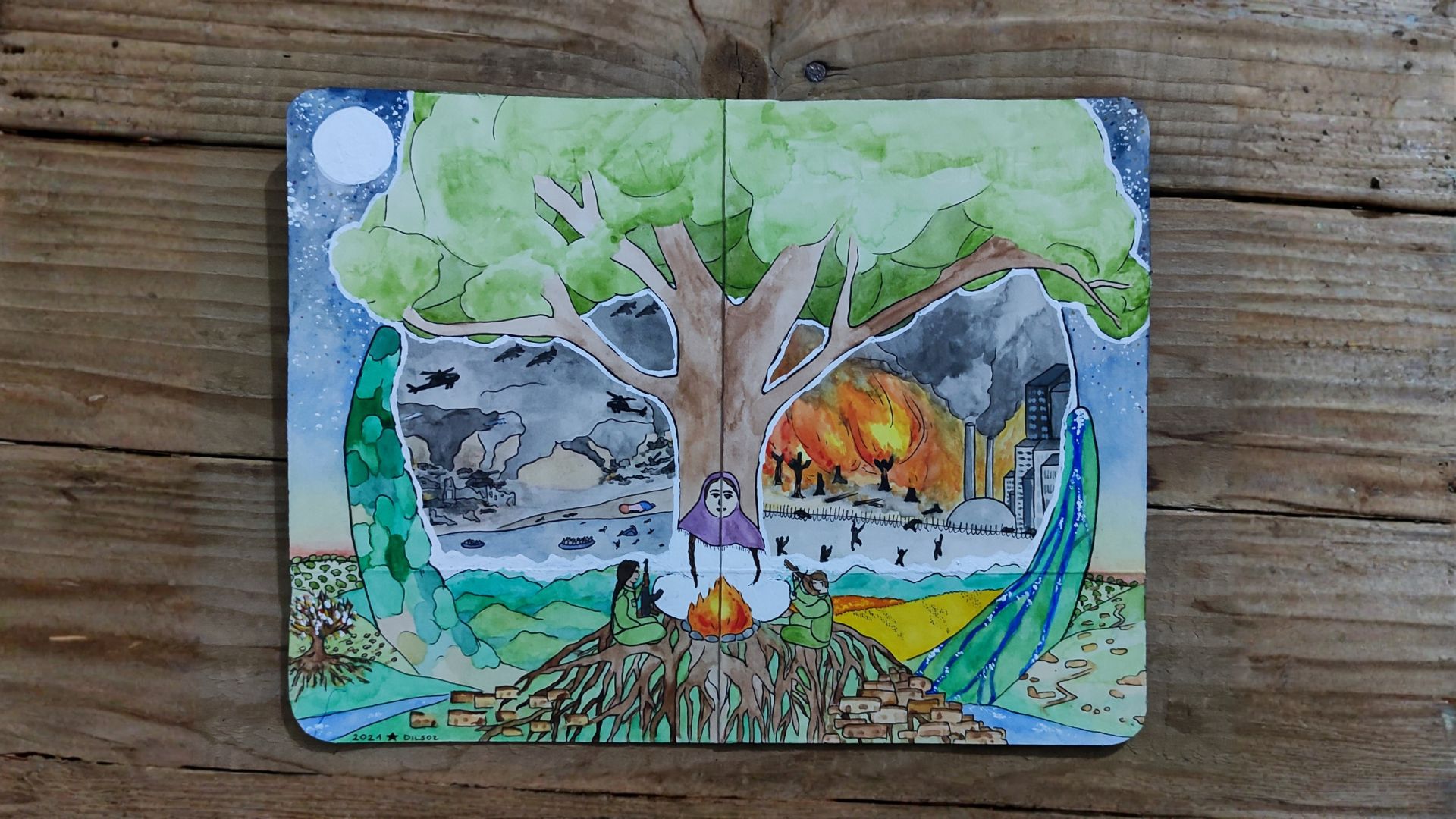
The Virtuous Stance of Existence: Resistance
We are republishing an article by Nagihan Akarsel, written for the Jineolojî magazine in 2019, to offer an opportunity for reflection on the concepts of existence and resistance, and how these two terms intertwine — especially in territories where living means precisely resisting annihilation.
Nagihan Akarsel
I am writing this text from a territory where living is synonymous with resisting. Resistance: a word that embraces all the meanings of one’s own territory. Life itself – the virtuous stance of existence. The manifesto of the greatest freedom movement of our time begins with the phrase “Resistance is life”. The formula of a conscious organization that seeks, protects and defends truth, by clinging to this phrase. A way of existing that responds with an integral voice, in the context of time and space, to Deleuze’s statement: “When power targets life, life itself becomes resistance to power”.
Writing what one lives is a difficult act. Expressing the meaning of what one has lived from the perspective it deserves is even more difficult. This feeling can subvert all the approaches one would like to undertake, because you find yourself in a period in which the heartbeats of those who embrace the meaning of resistance begin to be counted; a period of those who resist by dedicating their own bodies, cell by cell, to all the sufferings of their own territory; a period of the most beautiful people of our era, who reveal the meaning of resistance with their lives.
And in this time, you visit the places of resistance remembered in history. You stop in a place where Mahmut, who is said to smell like the kofi1 of the grandmothers of Kobane that is, like the sun, has just bandaged his wounds. You witness the resistance of a Turkmen mother in Manbij, who knows that all the calculations of the forces of power will be thwarted by wisdom – by women’s wisdom. You clothe yourself in the hope of Şirin, who carries Afrin’s wind with a tear in her eyes. You see how the women of Shahba, who recreate life, complete each other with their positive energies. In Aleppo, in the Sheikh Maqsoud neighborhood, in front of a destroyed house, your eyes rest on the still vibrant green of a grapevine. You admire with wonder the life that resists, despite everything. You listen to Hedar’s voice, telling you how mothers who follow the women’s resistance line in Sinjar, set out toward the mountains with their sacred objects in their arms. Each of these stories tells us about different methods of resistance. In a territory that the forces of powerof the 21st century constantly attempt to occupy, these stories tell us the philosophy of a life, of a resistance that, while as it says “Resistance is life,” defends its own land, culture and values.
Each word of this text was written in a period when the clock hands move toward resistance, and in places that identify with resistance – Kobanê, Manbij, Afrin, Shahba, Aleppo, and Sinjar. This text was based on cultural codes that equate life with woman, in a territory where resistance is identical to life. It intends to contribute, even if minimally, to the universal definitions of resistance, by deciphering the codes of local resistance. It is based on a method founded on the connection between the general (universal) and the particular (local).
A Paradigmatic Concept: Resistance
Resistance is a concept that corresponds to a paradigmatic meaning. In the Turkish dictionary it corresponds to “endure, protect.” In English the word “resistance” means boycott, or protest. In German it corresponds to the word “Widerstand,” meaning opposition, and similarly in Spanish “resistencia.” In Kurdish, “berxwedan” is defined as mobilizing all one’s resources to resist. In Persian and Arabic it appears as “mukavemet.”
In all languages it encompasses meanings such as enduring, not accepting, opposing. Moreover, in all visual, poetic, and graphic narratives, resistance is expressed as opposition. But resisting what? Or boycotting what? Opposing what? Here we find a series of answers such as: occupation, cold, hunger, injustice, suffering, oppression, war, fear, colonialism and genocide.
These answers reveal a meaning. A mentality. A conscience. A paradigm. Here it is necessary to define the concept of a paradigm. A paradigm can be defined as a perspective, a theory, or a worldview. Thomas Kuhn, who first used the concept in the sense we know it in his work “The Structure of Scientific Revolutions” published in 1962, shakes up the concepts most widely used in science up to that moment. Kuhn develops the concept of a “paradigm” against the traditional understanding which is based on the theses that change in science is evolutionary, that scientists’ work shows continuity, and that change and development in science are a continuous, interconnected, and cumulative process, like the positioning of bricks in building a wall. “Every paradigm is proposed as a response to a set of problems accumulated in a field. An indicator of this is the beginning of a certain questioning regarding a determined field. Criticisms increase. New research emerges. The discussion intensifies,” he states. For example, with the Enlightenment period of the 17th and 18th centuries, the period called the “Age of Reason” began. However, the paradigm associated with names such as Bacon, Descartes, Galileo, Newton, Wesley, Voltaire, Rousseau, Locke, Hume, Kant, and Adam Smith, whose roots go back to 1500 AD, is now in decline. The fact that all the sages of the Age of Reason were men is a topic that requires further analysis. This paradigm, called positivist/rationalist, becomes the paradigm on which capitalist modernity2 is based. Based on this paradigm, they argued that reality is simple; hierarchy is the principle of order; the universe is mechanical; the future and the direction to take are already determined facts; and change is quantitative and accumulative. They also tried to demonstrate that objectivity is necessary through a series of relationships based on causal relations. Since it began with Newton’s work “Mathematical Principles” (Principia Mathematica), the paradigm that dominates science today is defined as the “Newtonian Scientific Paradigm.” In this paradigm, the operation of a machine is adapted to the operation of the universe. Therefore, the worldview is also mechanical. Today, almost all ‘post-‘ approaches we know, from postmodernism to postcapitalist and poststructuralist approaches, are based on this great Newtonian paradigmatic transformation.
However, Abdullah Öcalan states that science needs a paradigmatic revolution, arguing that this paradigm does not define life, society, nature and women, and that it is power-centered.. He says “If there were not a serious imperfection and chain of errors in the fundamental paradigms and structures of democratic civilization forces, there would not have been so much failure. A new deep theoretical methodological approach is needed. Sociological methods submerged by the multitude of numbers tend to veil reality rather than reveal it. It is necessary to move away from discourses that legitimate official modernity. In this area, a radical scientific revolution and methodological breakthrough is needed.”
In the concept of Democratic Modernity, Öcalan expresses that what is most fundamental is the revolution of mentality.He states that in national and socialist struggles, action is the aspect that is generally in the forefront. In the book “Defending a People”, he particularly emphasizes that to understand the knowledge structures underlying paradigm change, it is necessary to address quantum physics. He indicates the importance of understanding the quantum world, and the world of the cosmos, based on free choices, which expresses intuition and freedom. The quantum world is somehow similar to the world of the Neolithic period, which expresses the characteristics of living nature, intuitive method, and free flow. On this basis, he states that developments in quantum physics have revealed the need for a new paradigm, and that this, surpassing Newtonian physics, is the infrastructure of a new paradigm.
A paradigm, from this point of view, expresses the knowledge structures upon which mentality and conscience are based. These knowledge structures also tell about the perspective of that system. This perspective encompasses life as a whole, from the individual to society; from Romani music to Frida Kahlo’s artistic touch resisting pain; from a flower’s breath to the history hidden in the texture of a stone. This paradigm is based on the accumulation of ethical-political societies in which life assumes the same meaning as resistance.
This understanding is at the foundation of the philosophy of Middle Eastern sages, from Zoroaster to Mani; from Hermes Trismegistus to Hallaj Mansur. Abdullah Öcalan very clearly expresses that this philosophy is nourished by the woman-centered agricultural-rural society. It is also important that quantum physics defines the human universe as a “microcosm” and as a “second nature.” This explains how everything sought in the universe can be found in the human being. The principle “Know thyself!” is therefore very significant, because it sees the universe not as a crude mass of matter, but as a living organism. Animism, which existed in natural society, in which women, who build life and have a natural connection with it, led the agricultural-rural revolution, is at the foundation of this understanding. Knowing that everything is alive and sacred is one of the fundamental ways to reach truth itself, and seeing everything as alive and interconnected is the method of this thinking. In this view, all components of nature are “one” – they are together.
It is also important to read, from this perspective, all of the resistance stories of humanity, which find their meaning in socialization. Some methods can be indicated: to express, as a source of a meaningful life, these resistance stories, manipulated and overturned by mythology, religion, philosophy and science; to acquire the necessary knowledge to give meaning to the land, to Kurdistan, and to one’s own existence; to create an awareness that becomes universal as one gives meaning to the local; and to base oneself on one’s own social force while attempting all this.
A Concept that Identifies with Oppression: Power
In all examples of resistance, there is generally a party that endangers existence, and those who resist take a position against that party. This opposition is above all a position against evil. Here we are faced with definitions such as oppression and injustice, and these definitions describe a way of existing – existing through power, domination, rape, war, destruction and migration. We could also say that these are basic ways of existing under capitalist modernity.
The knowledge structures on which capitalist modernity is based perform a function that legitimizes this mode of existing, which has modern science as its source, because modern science was realized through a great upheaval, in which man declared his domination over nature. However, at the beginning, the human being considered nature as a whole of which he was part, and tried to understand it. The reversal of this relationship by state civilization, or capitalist modernity, as a representation of the former, transforms nature into an object external to the human being. An object of knowledge and knowing. An object reduced to number, measure and logical relationship – and power continues its existence as a force that dominates over nature, society, and women that it considers as objects. We can state that power also has a paradigmatic correspondence. It is no coincidence that generally, when we speak of power, state civilization and the mechanistic paradigm, i.e., the positivist/rationalist paradigm which we mentioned above, come to mind.
Limiting existence only to the human being is the result of anthropocentric approaches. However, every living being that carries within itself the dynamics of life, and lives in the context of time and space, has a process of existence. Ignoring these processes, and defining them only through the study of the human being, also expresses the starting point of the power phenomenon. For example, when we analyze it in the scope of political powers, we see that its existence is always based on the state and its institutions. This also expresses a condition that requires that the body be compatible with political power and its economic purposes. A reality is lived in which those who do not conform to this are excluded, and such beings continue their existence as nameless shadows. Both the education of the individual through fear, and the knowledge of mythical and divine symbols that transcend them, contribute to enslavement. A character is created who feels worthless in the infinite universe, ready to feel guilty for every action they undertake.
Power ensures its status as subject, and its domination over nature, society and women, which it treats as objects, by multiplying bodies that consent to everything. By making the human body a machine, it creates in it some fundamental fears. Professor David Graeber, who held a seminar at the University of Rojava, explains this with two fundamental fears: “First, power creates people who feel bad in their free time. Second, it creates individuals who constantly fear losing their jobs and therefore work non-stop. The result is communities that do not think, that move only through orders. We can also call them mechanized objects. It is possible to speak of a lifestyle in which competition and ambition have taken the place of solidarity and sharing. Consequently, we can state that a human reality alienated from its own sources of existence has been formed.”
“Where Power Wounds You Most, There You Find Your Identity.”
Life is actually an active organization that contains rich forms of resistance – a form of defense. Self-defense and legitimate defense are also an expression of resistance. Passive resistance, active resistance, civil resistance, cultural resistance, moral resistance, ecological resistance, etc. As if to confirm Milan Kundera’s phrase, “Where power wounds you most, there you find your identity,” numerous methods of resistance become a voice, an action, a position, a lifestyle, that rises from the place where one is wounded.
For example, Gandhi explained his resistance by saying, which he called “Satyagraha,” saying “I do not give anyone the opportunity to walk in my brain with dirty feet.” Satyagraha is a form of resistance based on truth and the right to act without using violence. On September 11, 1906, in a theater hall in Johannesburg, South Africa, Gandhi proposed and put into practice Satyagraha in front of three thousand Indians, presenting it as a new strategy to protest against racist and separatist policies. Methods that involve important personal sacrifices. Examples of this form of resistance include non-collaboration with the enemy, non-violence, civil disobedience, conciliation, asceticism, hunger strike, and marches that last months.
Another method of resistance is biopolitics – resistance against biopower, which is an instrument of the mental structure of the mechanistic paradigm based on framing and controlling life through the digital network. Biopower, a method for keeping under control the free spaces available to the person, makes it so the individual does not feel a sense of belonging to any place. As Foucault says, “This person is domesticated in places like school, barracks, hospital, prison.” There is invisible violence, and this is done via many methods, from TV series to cinemas; from music to painting. It is important to develop biopolitics against this invisible power violence.
Examples of ecological resistance have also increased in recent years. As examples of social movements and resistance, beginning particularly with the global economic crisis, one can cite: the Arab Spring, Occupy Wall Street, the Indignados Movement in Spain, the Rebellion in Greece, the Gezi Park Resistance, the Landless Workers Movement in Brazil, the Amazon Indigenous Resistance, the Civic Council of Popular and Indigenous Organizations of Honduras, the Recovered Factories Movement in Argentina, the Educational War in Chile, the Mapuche Movement of Argentine-Chilean Patagonia, the ZAD Occupation Movement in France, the Hambach Forest Resistance in Germany, Standing Rock in Dakota, Cerattepe in Artvin, the Alakır River Brotherhood, and the Resistances to Keep Hasankeyf Alive. As areas of alternative life and resistance, they have also been an ethical and moral source for new resistances. In 2017, the Communication and Solidarity Network of Environmental and Ecological Struggles, took its place in the literature as a method of struggle and resistance.
Where is a Woman Most Wounded?
Women’s existence, one of the first spheres in which power was institutionalized, is at the same time the identity most wounded by power. For this reason, the definition of women’s existence, which has become the power field of dominant masculinity, is very important. Here, the need arises to define women’s nature, and in this context the importance of science emerges. It is important to respond to questions about why a science of women is necessary, and in this regard, the question comes to mind why scientific fields that study the 3,500 branches of mathematics, every organ of the human body, and even its details, do not study women.
Power has wounded women especially in four areas. The first: through oppression, rape, insults and massacres, it has transformed women into an instrument of reproduction. Power, which has made women the first domestic slave, has transformed her into property by keeping her in this state. The second: nowadays, women have been transformed into an instrument of sexual impulse and power. The third: she has been reduced to a free, unpaid worker. The fourth: capitalism brought about the reality of the commodification of women. Woman’s body, woman’s labor, woman’s conscience and soul, have been subjected to massacres. Women’s identity has been wounded.
In this sense, the responses to questions about how a woman defines her own existence, about what one wants to understand, and how to make it understandable, become important. When we consider the words ‘life’ and ‘woman’ from a complementary point of view, it is necessary to describe their existence welland to identify their meaning. It is important to emphasize the importance of Jineolojî to establish the connection between a meaningful life and women in a good, beautiful, and correct way.
The definition of woman as being is important. Spinoza answered the question of what the essence of being was by saying, “the desire of effort (conatus)”. Nietzsche said, “Will to power”, and Marx, “Labor power”. Heidegger, however, argued that such a distinction was not necessary. Ibn Sina tried to explain being with two fundamental principles. He called them the theory based on causality, i.e., the cause-effect relationship, and the theory of emanation, i.e., the theory of origin. Each theory discusses the essence of being.
Quantum physics, which defines being with the potential of becoming a particle in new moments, states that this potential acquires existence when activated based on conditions and the observer. Through the uncertainty principle, developed on the basis of subatomic particles existing as both wave and particle simultaneously, it is observed that a particle collapses into either a wave or a particle at the very moment of observation — an effect that inherently includes the observer itself.
On this theme, Abdullah Öcalan states,
“First of all, defining woman and determining her role in social life is essential for a correct life. We do not express this judgment in terms of women’s biological characteristics and social status. It is important focus the concept of woman as being. To the extent that woman is defined, it becomes possible to also define man. We cannot correctly define woman and life starting from man. Woman’s natural existence occupies a more central position. It is also so from a biological point of view. The fact that male-dominated society has reduced and obscured women’s status as much as possible should not prevent us from understanding the reality of women. The nature of life is more connected to woman. The extreme exclusion of woman from social life does not refute this reality, on the contrary, it confirms it. Man, with his tyrannical and destructive force, actually attacks life personified in woman. The hostility toward life and destructiveness of man as dominant in society, are closely linked to the social reality in which he lives.”
Women’s existence, within androcentric paradigms, has always been defined in relation to men. That is, woman is “she who is not man.” This definition not only does not express woman, but distorts her. Another definition is that which defines woman simply as female sex based on her biological characteristics, like the other “females” in the world of living beings. Certainly there are biological factors, but the essential is the study of social culture that is realized in the person of woman, and the inclusion of woman in this context. If existence expresses a structure that completes itself through its own nature, language, and culture, then woman has been prevented from revealing her own nature. This was done deliberately through specific ideological orientations. The expression of woman as being will make it possible also to define man. The breaking down of the boundary between emotional intelligence, attributed to woman, and rational intelligence, attributed to man, is also realized by defining women’s existence. The recovery of values, from which woman has been alienated and lost, and the practice of giving meaning to one’s own existence, will be possible and effective through a return to herself that woman herself will develop. As woman defines herself, she will define nature, the universe and humanity, because woman is a universal, social, historical, and integral being that draws her source from nature.
Woman’s definition of her own existence is a condition that requires knowledge. Knowing oneself also means developing one’s own awareness. It is important to consider the human being as “a summary of the universe”; to define them in historicity; to consider them as a sociological being and as a cultural vitality. It is a question of the human being who realizes themselves in the first nature, i.e., the universe, and socializes in their second nature, becoming a force of existence that has acquired will and power of thought. Sociality expresses the act and time of creating oneself. It is necessary to understand women’s resistance, or the methods that lead to women’s existence.
Women’s Resistance or the Methods that Lead to Her Existence
Women’s methods of resistance are at the same time women’s methods of existence. Revealing women’s methods of resistance also brings with it the definition of women’s existence. Jineolojî, which is a science of women and life, based on “a research method founded on the reality of women”, and on the fact that “science developed around women is the first step toward a correct sociology”, reveals women’s methods of resistance and, in a certain sense, will also reveal the definition of her existence.
Here, while we try to understand the hidden truth of women, the fact emerges that this truth exists through resistance. Writing this text from a territory where living equals resisting, also provides important reflections. A territory that, despite war, destruction, and migration, resists central hegemonic power with its own force and will, not abandoning, in a certain sense, its own land, culture and existence. While the resistances of “those who love life enough to die for it, and of those who have set out as their companions” continue, it is as important as it is difficult to explain the fact that the meaning with which resistance (which is a form of existence) is clothed in our territory, is life itself.
The definitions of Jineolojî, which is in a state of perpetual becoming and change, are important for understanding the meaning of this resistance. It is also important to emphasize that Jineolojî opposes the current positivist understanding of science. Jineolojî is a science that develops a critique that looks at woman and her connection, weakened by positivist scientific understanding, with life, society and nature, and aims to create an alternative. Its search for solutions to the problem of existence and the production of alternatives, encompasses a living and dynamic process for the nature of this new science.
In this sense, it is important to reveal the role of semantics as an act of understanding history and sociology. It is an important method to touch on, with a perspective of Jineolojî, the fact that history continues to exist as a sociological being, and sociology as a historical integrity. Reconsidering history and sociology with such a perspective reveals that women’s methods of resistance are at the same time the fundamental moments of women’s existence and life, and these moments carry within them the codes of sociality that women have carried and protected until today.
Some Examples of the Theoretical Foundations of Women’s Resistance
The experiences of women who fought in Kobanê against ISIS, the darkest force of the patriarchal system; the women who continued the resistance in Afrin against NATO’s second largest army, clothing themselves with the knowledge of their own land; the women who resisted with their culture and force against rape, genocide, and femicide in Shengal, where women’s resistance has been preserved until today and which serves as a stem cell, are among the most important examples of women’s methods of existence in our era. The fact that the Kurdistan Women’s Liberation Movement, which flourishes on its own roots, has realized the second women’s revolution in the place of the first women’s revolution3, demonstrates a surprising dialectic between history and the present. It is decisive that women’s resistance preserves and bases itself first of all on its own roots, on historical memory, and on cultural vitality.
Women must overcome the alienation they live, above all by creating a common will with other women. The theory of separation4 and, correlated to it, women becoming aware of their own nature, love for other women, and struggle against their own traditionality backwardness, also constitute an important method. This method has also been the source of an organization with the founding of a women’s army, and the formation of parties and associations in the Struggle for the Freedom of Women of Kurdistan.
Starting from the fact that one characteristic of being is feminine, and the other is masculine, it is also important to struggle from a position that is based on men’s transformation. The project of men’s change and transformation is central, because it makes real the thesis that women’s freedom is society’s freedom. On this difficult path, which goes from the project of changing and transforming men, to the theory of a free cohexistence,, women’s definitions and methods of struggle are of determining importance. It is important to analyze the man-woman relationship, defined as the most intimate relationship, on the basis of its universality and its social connections, taking as a basis that “the private is political,” making the private public and the public private. This method of analysis also becomes the method for correctly forming the foundations of sociological knowledge.
It has vital importance to bring to light the knowledge of the experiences of women who seek answers to the question of how to live; who share their knowledge in temples and in rooms where women practice self-consciousness; or in homes and places of education. One of the tasks of highest priority for Jineolojî, which is based on the knowledge of experience, is to reveal these methods that are the dynamics of women’s existence. Methods such as analysis, empathy and feeling, the development of dialogue, criticism and self-criticism, applied during the sharing of this knowledge, are also issues that must be addressed one by one.
Conclusion
It is not possible to provide in a single article the meanings of resistance that embrace the entire universe, from the individual to society; from woman to man; from the living to the non-living. In this writing, which focuses on the connection of life with resistance, our purpose is to emphasize that women’s methods of resistance, in a territory where the saying “Living is resisting” holds, equate to the methods that lead woman to exist. Our purpose is also to make an introduction to the relationship between the resistance on which the democratic, ecological paradigm based on women’s freedom is founded, which defines woman beyond being only a gender but also as the essence of sociology, and to unmask the power upon which the mechanistic paradigm is based. It is to indicate the importance of the knowledge that women’s resistance will occur with the strong creation of her connection with nature, society and life, from which woman is most alienated. In the time and space in which we find ourselves, in this sense, living and dynamic examples of resistance are being experienced. It is to create concepts, theories and institutions, that show the world this beauty based upon the beauty of those who are bound to freedom at the cost of their lives.
We are now in the era in which the motto berxwedan jiyane (resistance is life) is revitalized as serkeftin jiyane (victory is life), through the strengthening of the philosophy, theory, and organization of resistance, which is one of the fundamental methods of existence of the Democratic Modernity system and its paradigm based on democracy, ecology, and women’s freedom. This is founded on the commitment of all the resisting peoples throughout history, clothes itself with the awareness of their resistance, and carries with it an alternative life perspective.
1 Kurdish women’s headdress.
2 Capitalist modernity is based on capitalism, industrialism, and the nation state, and is in contrast to democratic modernity, which is based on direct democracy, social ecology, and women’s liberation.
3 The Neolithic Revolution, which took place in Mesopotamia, is considered the first women’s revolution due to the important role that women played in it. Today, in the same geographical area, the Rojava women’s revolution is considered the second women’s revolution.
4 In 1996, the Womens Kurdish Movemente published the “separation theory.” In this theory, they analyzes the dynamics by which women are seen by men as a product and continuation of themselves. They asserts that women have a dominant male mentality within themselves, and that they must break with this mentality in order to overcome patriarchal domination. This is why this theory is also known as the “theory of infinite divorce.”