
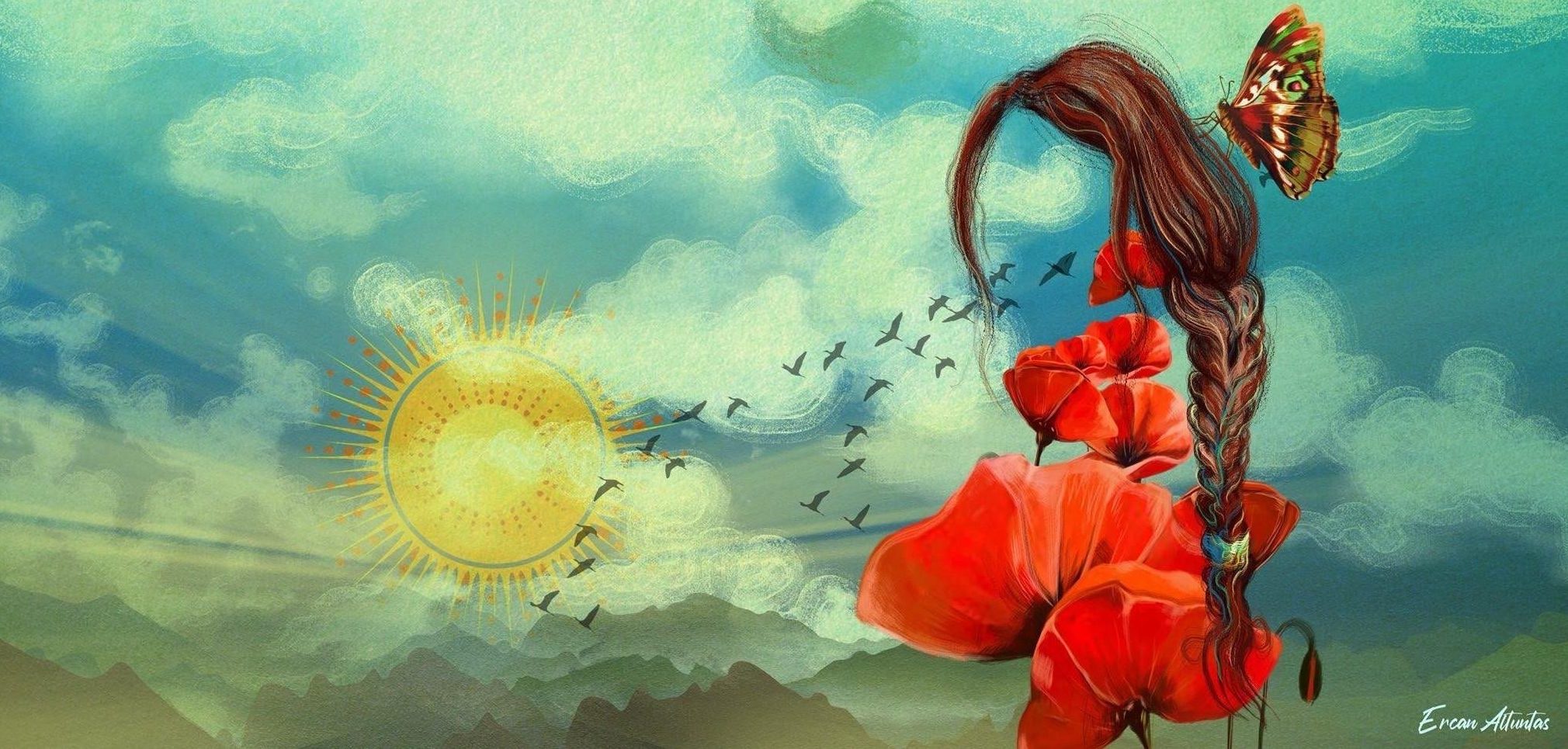
The story of the four butterflies
Necibe Qeredaxi, Jineolojî Academy
Have you ever heard the story of the four butterflies?
It is a well-known story that is often told to illustrate deeper meanings and experiences. Simply put, four butterflies see a burning candle. The first butterfly looks at the candle from a distance and says, ‘I know what that is.’ The second butterfly flies closer, feels the warmth and says, ‘I know more than you do, because I have felt the warmth.’ The third butterfly flies very close, burns part of its wing and says, ‘The fire burns.’ The fourth butterfly flies in and does not return.
There are things that cannot be learned through words, observation or mere perception alone. Some knowledge requires lived experience – even if it means making a sacrifice.
In truth, the matter is not so simple, because ultimately this story speaks to us about the difference between theoretical (mathematical) knowledge and experience-based knowledge. In many mythological tales, butterflies are a metaphor for the paths to truth (free life and its price). This story is written in poetic language that wants to be understood and interprets meanings. Simple, but profound. Because, as Nagihan Akarsel said, ‘Simplicity is a virtue.’
The first level is only knowledge from a distance, like the state of the first butterfly; an external image in the mind that, compared to the truth, is not an experiential image.
The second stage is sensory knowledge. Although feeling itself is a form of ‘concentrated thinking’ and allows for empathy to a certain extent, merely approaching and feeling is not enough to recognise the truth of things. Although knowledge through the senses is an important step in human intellectual development, as in Aristotle’s philosophy and empiricism, it remains incomplete.
As for the third state, it is the state of partially entering the fire and having the courage to partially face knowledge.
The fourth state is experience-based knowledge and the state of becoming one – but a becoming one in which the self is realised. It is that social state in which the self comes into balance, becomes the fuel of the candlelight itself, and leaves a big question for those left behind, on a level that they must understand, feel, perceive and set in motion.
This view differs greatly from the Western perspective in Eastern thinking. Westerners criticise the state of the third and fourth butterflies because they consider them not individualistic enough, as they do not pursue their interests selfishly and do not instrumentalise their minds. Of course, there are also many in the East who have become copies of this Western view.
But in the philosophies of the Axial Age and the East, the fourth state is the fire of truth itself. In the end, the story tells us: those who only speak do not know. Those who feel are only halfway there. Those who show courage and face the truth attain knowledge. Those who get into and do not return reach the state of existential fire. What remains are the ashes from which being can come back to life. Only people who think freely can recreate themselves from these ashes. For those who leave and do not return, their social memories and goals remain.
Dedicated to those who gave their lives for freedom and to those who understand.
In these days, when there is such an organised and planned attack against the paradigm of democratic modernity, we need not only a mode of expression full of responsibility, but also a connection between feeling, thinking and acting. For ultimately, human beings themselves are the mirror of what they express.