
Why the democratic nation must be indispensable
Ronahî Malatya, Jineolojî Academy
The Middle East is once again being reshaped by capitalist hegemonic powers in accordance with their own interests. In particular for the Kurdish community, and more broadly for the societies of the Middle East, this represents a critical turning point. For this reason, the process in which we find ourselves truly corresponds to a historic moment. Only those who possess a correct historical perspective, who truly understand the present and interpret it correctly, can build the future on the right foundations.
It is Abdullah Öcalan that, with deep foresight and a profound historical consciousness, prevents the repetition of history against the Kurds, and transforms it into an achievement. Even under the isolation conditions at İmralı, and with extremely limited means, Abdullah Öcalan developed, thread by thread, with great effort and patience, the process of democratic society and peace, thereby laying its groundwork. Through the democratic, ecological, and women’s liberation paradigm it presents, it serves as a beacon of hope for everyone across the world who seek an alternative way of life against the way of life offered by capitalist modernity. By offering Democratic modernity as an alternative to capitalist modernity, and the Democratic Nation as an alternative to the Nation-State, it renders a viable holistic perspective in place of a fragmented one. The elimination of oppression, exploitation, otherization, subjugation and enslavement, is made existential through the indispensability of raising consciousness, engaging in struggle and organizing.
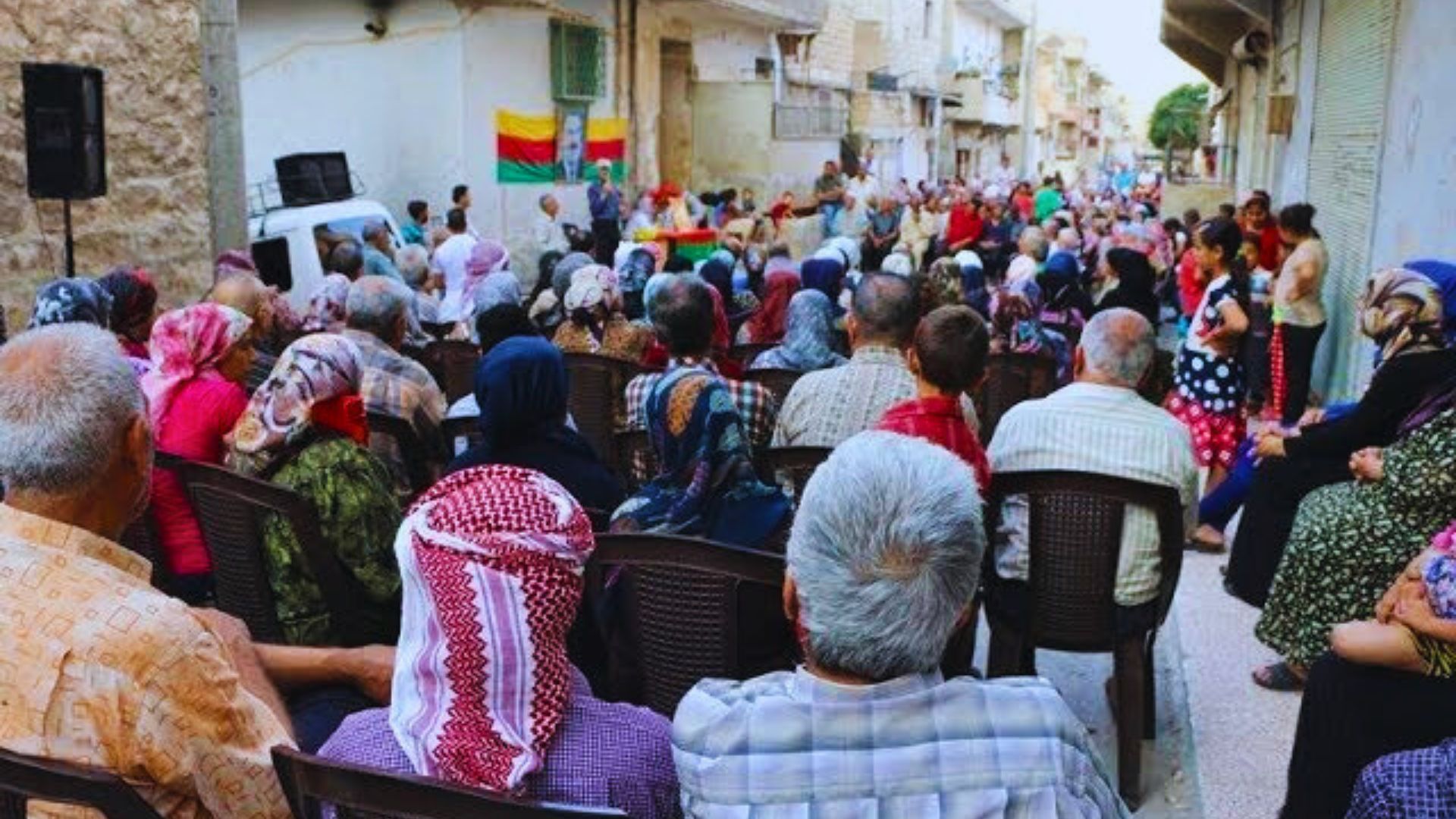
The Democratic Nation being implemented in Rojava is led most actively by women, precisely because it is grounded in the democratic-communalist, ecological, and women’s liberation paradigm. In this regard, the attacks by those who hold a Nation-State mentality and an ISIS mentality, first against women’s values and against women, are not an ordinary approach — they are ideological. The Rojava Revolution is attacked so ruthlessly precisely because it is a women’s revolution. The war waged specifically against women, and more broadly against the Kurds, was perceived by the world community as an assault on human values. The fact that people across the world, and in every part of Kurdistan, have risen up to defend what they see and know to be the sprouting of human values in Rojava — values that capitalist modernity has destroyed — is no ordinary occurrence. The existence of the Kurds and their demands for a free life have become the demands of others as well.
When the Democratic Nation becomes a project of unity, solidarity, and unity among peoples, the hegemons who hold a Nation-State mentality invariably sow the seeds of discord among them. Sowing discord among societies and peoples in order to turn them against one another is the most fundamental method of the capitalist hegemonic powers; therefore, they will never allow unity and solidarity to develop. They will always obstruct it. They desire to create deep chasms between the Arab people and the Kurdish people in Rojava in particular. The attempts to provoke conflicts between them amount to the destruction of the spirit of brotherhood and sisterhood, unity, and solidarity among peoples. A collective memory is being constructed to the effect that ‘peoples can never live together.’ In reality, this perspective is rooted in nationalism. Nationalism is indeed the very source of sustenance for the Nation-State. Its own interests perpetually require that border wars, sectarian wars, and conflicts among peoples be kept alive. Consequently, everything is being done to prevent the Democratic Nation project developed in Rojava from finding a way to exist. Yet, through the concept of the Democratic Nation, a distorted life can be corrected and a righteous life can be made possible. The sovereigns who do not want this are targeting the Abdullah Öcalan’s Democratic Nation project through the war they have waged in Rojava. The fact that hegemonic and Nation-State powers attack so shamelessly; that nationalist, religio-sectarian, and sexist approaches are driven to such extremes, stems from their ideological nature.
The source of sustenance for the Democratic Nation, which is the alternative to the Nation-State, is the commune. The Democratic Nation — that is, the project of unity, solidarity, and unity among peoples — finds life through the proper organization of the commune. How should the commune be constituted, both in mentality and in structure? It has no relationship with statist instruments of civilization, such as power-seeking and statecraft, nor with violence. It rejects the usurpation of governance over society by rulers, and it rejects centralism. It takes as its foundation a democratic, participatory, creative life in which differences coexist.
Abdullah Öcalan states that, upon embarking upon the construction of the commune, the values stolen from the primordial society — and therefore from the communal society — by the castic killers [1], are reclaimed and returned to society as a democratic society, and that the most fundamental problem of our time — the problem of equality, democracy and freedom — can be resolved through the construction of the commune. The alienation, otherization, and mentality of enslavement created by the castic killers, can be eliminated only through the mentality and the construction of the commune. Nourished by the democratic-communalist, ecological, and women’s liberation paradigm, the Democratic Nation, built through communes at every level of life, resembles a garden of a thousand colourful flowers. Why then should we need the Nation-State, which only serves the interests of a handful of sovereigns and hegemons who are a plague upon humanity and upon nature?
[1] It is a term coined by Abdullah Öcalan in the Manifesto for Peace and a Democratic Society. He uses it to describe a form of power, patriarchal structures of domination, and mentality that is based on the destruction and annihilation of free, communal society. We will examine this term and the associated power analysis more closely in the near future.