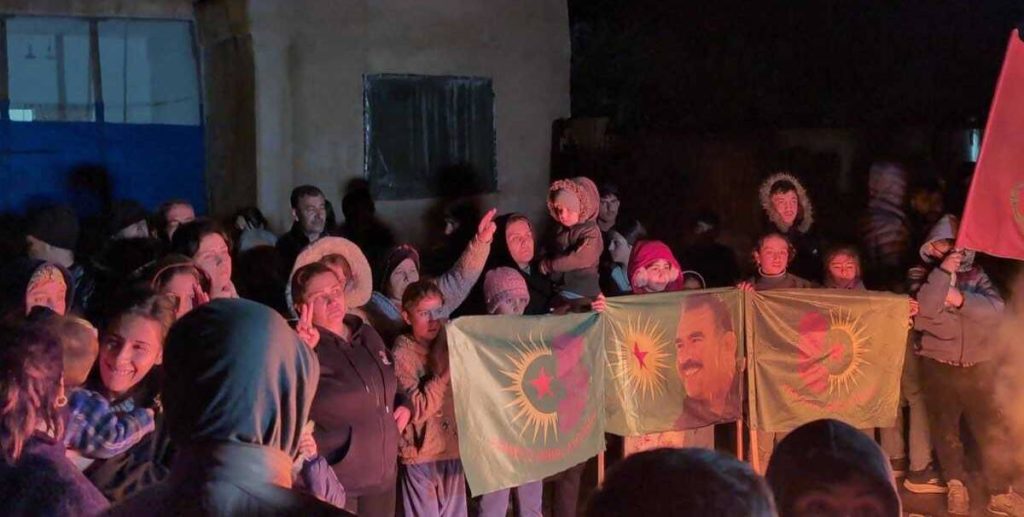
Defending life. Voices from the siege and the resistence: The women’s commune of Aleppo
Andrea Wolf Institute, Jineoloji Academy
com
“The women’s commune should be the basis of a true socialism, because if the women of a society are not liberated, society can not be free.”
Nûjiyan, a member of the women’s commune in Aleppo.
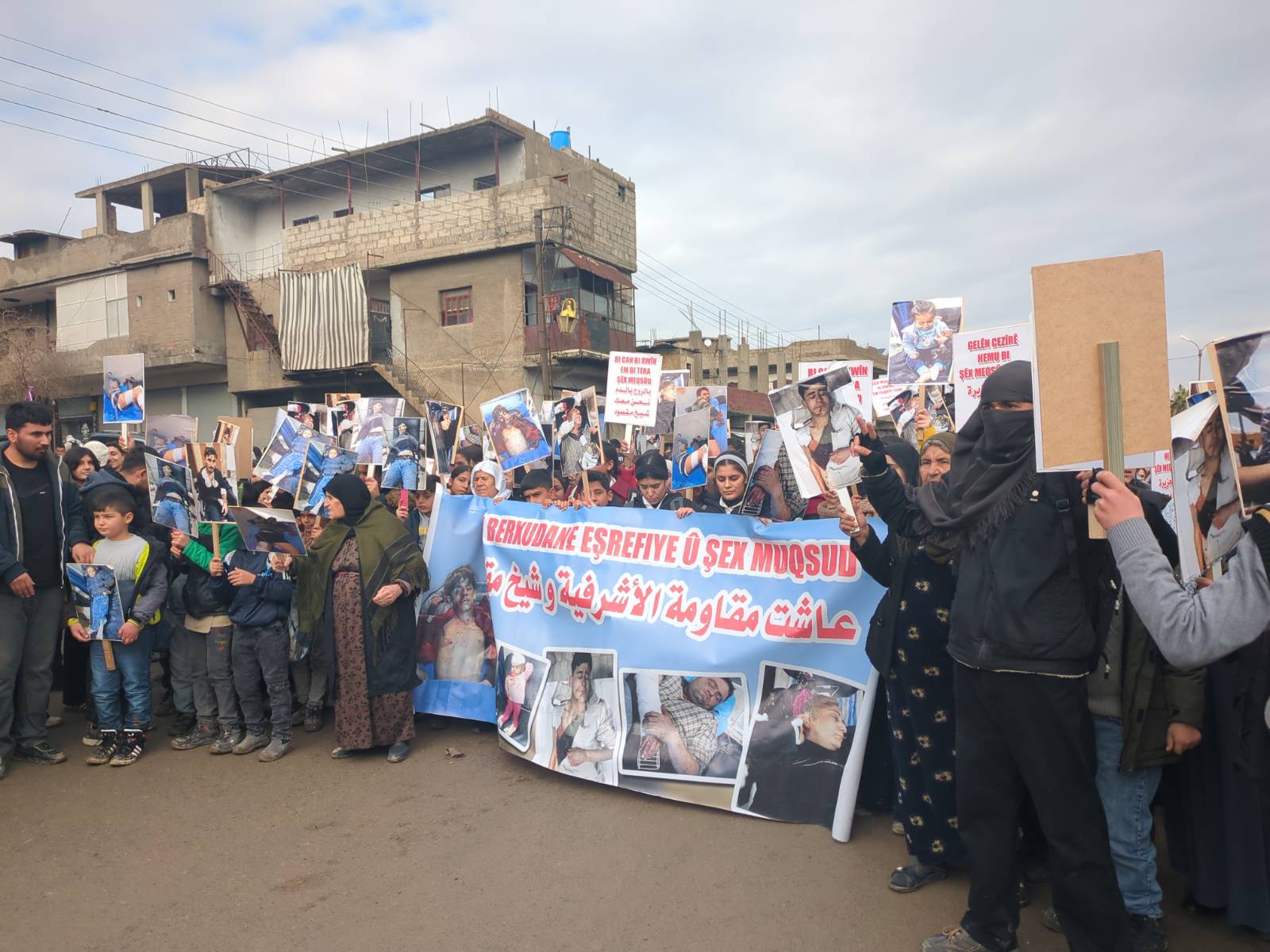
On the 6th January the Syrian Transitional Government (STG), started attacking the mostly Kurdish neighbourhoods Sheikh Maqsoud and Ashrafieh in Aleppo. In a joined offensive with multiple jihadist milicias and the direct involvement of Turkey tanks, armoured vehicles and air strikes were used against the people. And still they decided to resist. The STG declared both neighbourhoods, including all the people that stayed inside, as legitimate military targets. They cut off electricity and blocked the roads. The only hospital left became target of heavy attacks including the use of chemical gas. Nevertheless all international powers stayed silent and even gave direct signals of legitimization.
The women of Sheikh Maqsoud and Ashrafieh, put the intentions behind these attacks in a call for intervention into very clear words: “What we are experiencing today is not a local affair, but rather a regional earthquake intended to bury any glimmer of hope for a democratic future in the Middle East.” This is taking place during a crucial phase for Syria. The March 10th Agreement between Mazloum Abdi, the General Commander of the Syrian Democratic Forces (SDF) and Al-Sharaa (a.k.a. Al-Jolani), head of the STG, was starting to set the basis for a democratic and decentralized Syria. Central topics like the controll over the borders, economy, agricultural land, oil and energy resources were supposed to be coordinated through the establishment of committees. Equality and freedom for all people were supposed to be recognized and human rights put under constituional guarantee.
It was followed by another agreement, specifically about the two neighbourhoods of Aleppo, that have been part of the Democratic Autonomous Administration of North and East Syria since it’s establishment in 2012. The 1st April Agreement aimed at integrating the self-administrated neighbourhoods into the general city administration, while keeping their autonomy. It was stiputaled that the People’s Protection Units (YPG) and the Women’s Protection Units (YPJ) – together under the umbrella-organisation SDF – would transfer the responsibility for the safety of the neighborhoods to the Internal Security Forces (Asayish) and leave Aleppo. And so they did. In a message from the prison island Imrale, the leader of the Kurdish Freedom Movement, Abdullah Öcalan, affirmed that the March 10th Agreement “is not merely a political option, but a real historical necessity” and a huge opportunity to be taken.
Why, despite of all these intentions, still another war broke out in Syria?
The violations of the agreement by the STG are changing the situation once again, pushing the region towards total war and an unprecedented humanitarian crisis. This is a war about the future of Syria, the Middle East and the world. It’s a moment, in which once again the masks have dropped and the states are showing their faces. The STG has chosen the line of war. The line of the centralized, fundamentalist and oppressive state. But the resistance of the people in Rojava is continuing to prove the strength of the organized society and it’s will for freedom and peace. To understand the present it is fundamental to look back into the history of the people and this land: what kind of geography and sociology has created nowadays Aleppo?
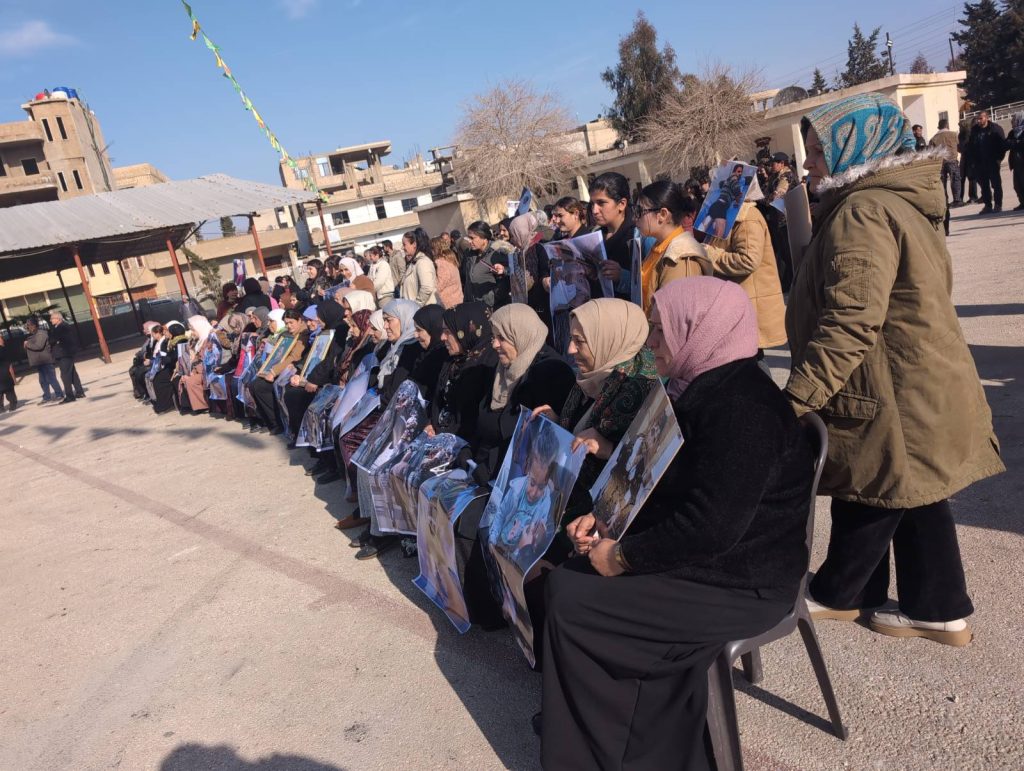 Situated in the North-West of Syria, Aleppo is a crucial point in the region, whose inclination can disrupt the balance of all it’s surrounding areas. Since the dawn of history, this region is a region of connections, where unity in formed from diversity, on a geographical, sociological and cultural level. Rooted between the Anatolian plains to the North, the Arab desert to the South, and the Mediterranean sea to the West, the city has a clear strategic role in the region and gives shelter to many cultural identities. But Aleppo is more then that: from the perspective of Turkey, it is the ‘lost province’, the third center of the Ottoman Empire after Istanbul and Cairo. Actually, all the mostly Kurdish populated area of Northern Syria is considered as included in the borders of the Turkish nation, referring to the National Pact of 1920, that is nowadays still the base of the Neo-Ottoman discourse and the fascist-nationalist ideology of the Turkish state.
On the other side, from the perspective of the people, Aleppo is a city of resistance and could have become a model of the ‘democratic nation’. The grassroots democracy system of people’s communes and councils, that was practiced in Sheikh Maqsoud and Ashrafieh, could have become an example for the whole diverse population of Aleppo. Since the Turkish occupation of Afrin in 2018, thousands of families moved to the two neighborhoods, bringing their heritage, identity and spirit of resistance. Even more Afrinian people arrived after being forcibly displaced for the second time from Shehba, when it was attacked and occupied in late 2024. Each time this meant to face the pain of seeing the life they built up being destroyed again.
Due to the fact that most of the people, that lived in Sheikh Maqsoud and Asheafieh, had been internally displaced one or two times before, the decicivness of all the women to stay in Aleppo and fight, protecting their families and their houses was even stronger.
“Each time this meant starting over. For three times in my life I had to create a new women’s commune to organize our lives. This may be difficult for some of us, but when you experience the war from within, the morale has to remain high, so every time you start from the bottom and create a new commune”, said to us a woman from Afrin.
In the last days, during the attacks on the city, the council of communes of Aleppo gathered to decide what to do: evacuating the population or staying to fight? It was the women’s commune that took the stance that the people should stay and resist, and convinced the rest of the council. As we have seen over and over again, it’s women who take the vanguard role in waging people’s resistance. This is not a war about conquest, but a practice of self-defense of a revolutionary resistant society. It creates the Reality of the Fighting People (Rastiya Gelê Şerker) by creating a mentality of resistance, that enables the people to stand their ground and defend themselves. It’s important to underline that the one of the people’s resistance it’s not only a military reality: the first way to take part in it is organizing life, risorces and aids.
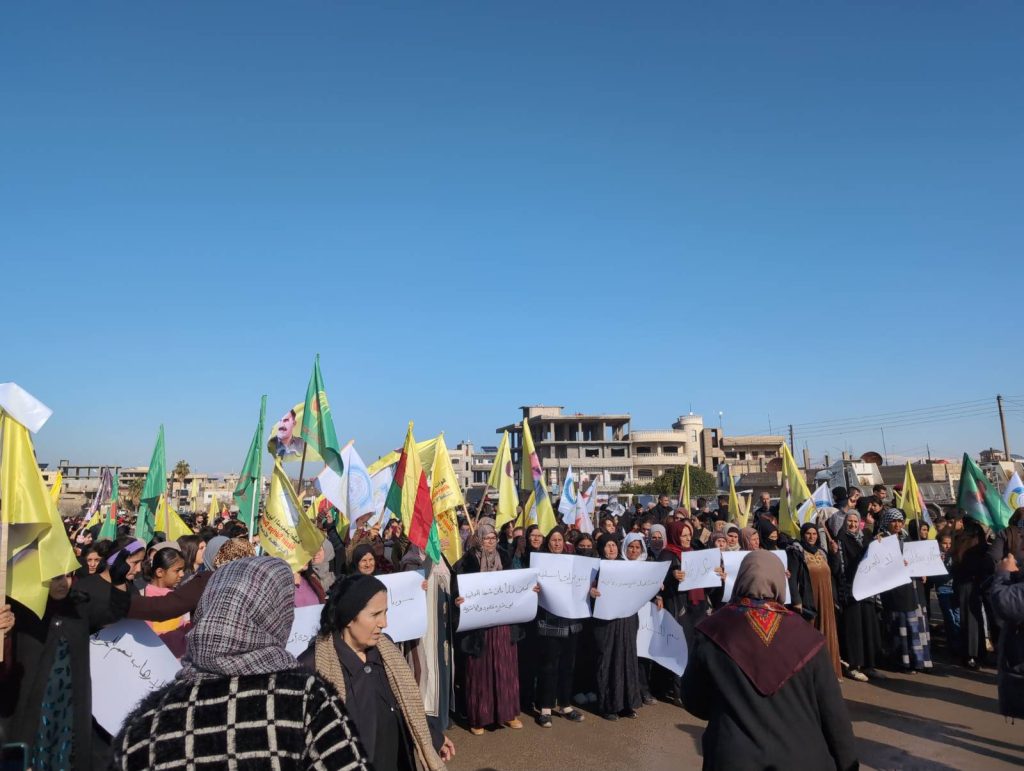
If we think about what kind of society is able to take on this task, it appears clearly that the first thing needed, is a strongly rooted society. Being rooted means to be deeply connected to once people, culture, land and nature. This makes a welatparez society, a society that defends it’s home land. It needs deep knowledge of oneself, not only as an individual, but in a way that sees the individual as part of the life, of the land, of it’s history and values. Each part of society participates during the people’s resistance in different ways, according to their education, abilities and organization. Together with groups of young women, the women’s communes are taking a leading role, holding society together while being clear in their purpose. Fatime, the representative of the women’s commune in Aleppo, shared with us the long story of the communal system in the city.
She said:
“In June 2015, the first commune in a neighbourhood in Aleppo, in Sheikh Maqsoud was created, in the name of the first female martyr of the neighbourhood, Şehîd Gulê Selmo. Seven communes were opened there, a system was defined.” First, she explained, the protection committee was formed ”so that women defend their neighborhood, their house and their family, than the economy one and the committee of reconciliation, in order to solve problems in families, between neighbours and between women and men. And in addition to those committees, the committees of arts and culture was build up. And the committee of education, because it is known: without education there can’t be a truthful life
With the beginning of the Rojava Revolution, the necessity of having a women’s commune became a very practicaly clear. Selma, a woman member of the same structure in Aleppo, said: “It was necessary to build up a women’s commune. In the beginning the house of the people [Mala Gel] was created and afterwards it was necessary to build up the women’s commune in 2016.” Another woman, Ikrem, talking about the beginning of 2018, in the neighbourhood of Ashrafiyeh, added: “the displacement took morale from the women, a little bit, so the members [of the center of women, navenda mala jin] gave some moral to them. And the members were doing new actions. For three years they continued. After the women’s commune, the women’s council was created with three coordinators at the beginning. […] Their work is based on ideological education, a system of methods and procedures for the works and discussions with women, which help them to develop and get rid of the patriarchal ideology.”
The whole life in the self-administrated neighbourhoods – in terms of defense, administration, justice, health, economy… – was organized according to the communal system where everyone could play their role. This is not changing during war. The approach of the people’s resistance get’s it’s strenght from the participation of a big part of society.
“Our work didn’t stop, morning and evening, until the day of war, the day that our neighborhood was besieged, our work always continued. […] We were even more with the people. The women didn’t stop in this situation, they weren’t afraid. We did more, we were educating, we gave strength, that is people’s resistance.” These are the determinated words of Nûjiyan, a member of the women’s commune. Their work starts from this: building connection between women, creating relations.
Trust in one’s own gender is a fundamental basis for creating a community of women. And making it strong requires work that is both extensive and precise. To do this, it is necessary to start from the houses full of colours, the kitchens full of voices, and all the places where women live, which constitute their world. Talking to them, getting to know them, understanding the problems of their daily lives, builds the basis for making suggestions and asking questions, that bring them closer to understanding themselves and their desires as subjects. So they become capable of choosing freedom: this is the first task of the women’s commune. Women’s thought has been suppressed and devalued for ages, and this had an impact also on the possibility to develop a mentality that refuse the master-slave hierarchy of patriarchy, state and capitalism. Without free thought, free life is impossible. The relationship between them is reciprocal: the free will puts the free thought into practice. From this conscious acts, decisions derive, which can give new shapes and colours to life.
For showing the importance of the women’s commune, we start from ourselves: I as a woman will organize myself, will get to know myself, will get to know my truth. […] For changing and influencing women in society, the commune mostly does discussions, the members go visit families, prepare topics that need to be discussed. We don’t just go around drinking coffee.
Knowing oneself, getting close to one’s xwebûn – becoming one self – understanding one’s own dreams and desires is the first step in choosing to fight. It’s about making them a reality and being able to analyse the dynamics of domination that we live in well. In this process, education plays a central role and that’s why women who organize themselves in the commune devote so much energy and time to discussions and seminars in their daily lives. The path of collective self-awareness as women is the path of liberation for the whole of society and opens the way for the creation of courageous women, convinced in their stance for a democratic society that rejects hierarchies and domination, women bound by honest and deep friendships.
The reality of war is the reality of patriarchal domination par excellence and forms the basis of the mentality of both ‘progressive’ nation states in Europe and forces of organized violence such as fundamentalist groups. “During the time after the defeat of the government of Bashar Al-Assad and the taking over of Ahmad Al-Sharaa, we saw that in all the mentalities: nothing changed, the same obstacles, the same mentalities, they want our identity even more, to surround us. […] we see this as fanatic, violent and fundamentalist. We don’t see this as Islamic. Islam was build up upon believe and moral, it’s about a colorful society, where every part of society can stay. […] When the fanatic and violent culture spreads in our society, that is very dangerous for our society. It’s not our culture, that’s why we work even more against that mentality.” Nûjiyan shared with us.
A society that knows it’s own culture is a society that knows what it wants to defend. It becomes a reality that no attack, no weapon, or other form of violence can bring down. Selma also told us about the importance of this awareness in women: “When this new government was made, their first topic was to commit violence against women. We as women defend ourselves in every way inside of Sheikh Maqsoud against the state mentality. And we take strength from our thoughts and create unity. We create the spirit of Hevaltî between women. […] This is seen as women’s socialism, we unite the spirit of women, our spirit and our friendship, we unite our unity and live our communal life, we do not live individually, that is why we are strong.”
As much as a population is taking it’s life into it’s own hands by maintaning it’s 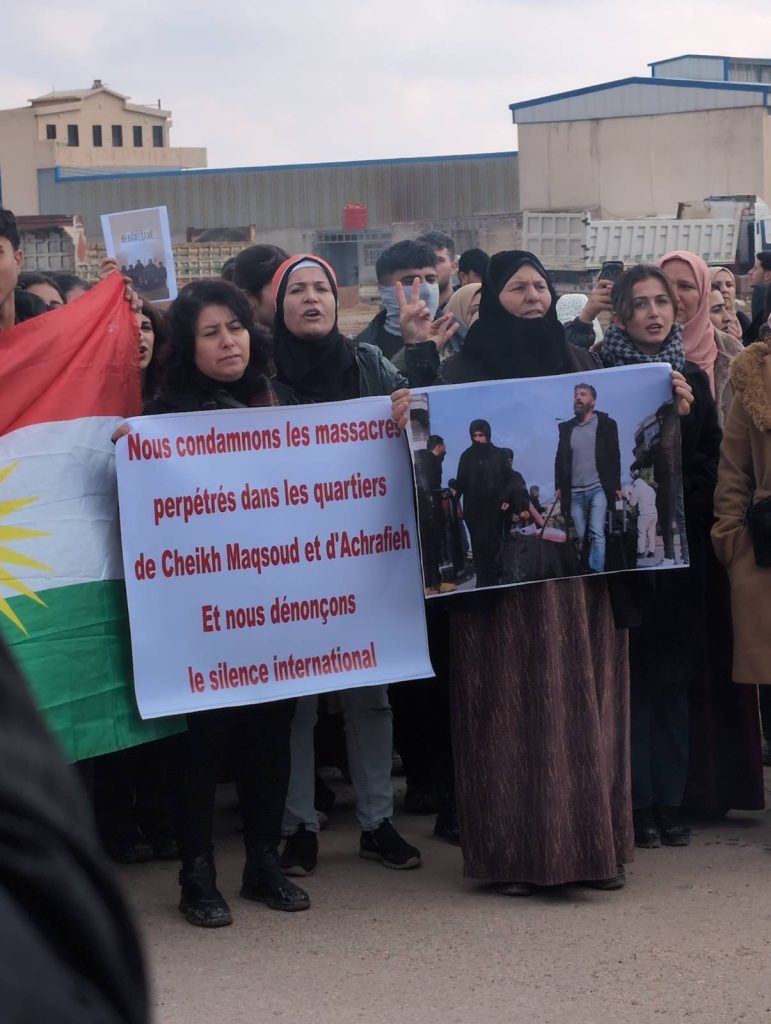 communes, committees, coucils and self-administrated institutions, as much the people will be able to decide to stay in times of war to defend their revolution. A society that can defend it self is not just ready for military battle, it has knowledge, Hevaltî and will as it’s weapons of mental self-defence. For women this means an especially big revolution within the revolution. From silenced objects, who’s lives are limited to the sphere of the house and family, the autonomous organization of women, the education and active participation in revolutionary works, has made them recover their strength, and become vanguards of society again.
Selma continued to say: “As women we have many needs, we need to defend ourselves, in war, against the patriarchal mentality, because the patriarchal mentality sees women as small and doesn’t accept the presence of women in war. There is also the need for education, for knowledge. As women we educate ourselves, we develop ourselves, because in war it’s a nessecity for a woman to protect herself also in this way.”
For a woman in war, protecting herself means protecting the future, choosing the path of conscience, of the value of life, of the earth. It means being aware of our way to growing up in society, of the values of communal life, of the positive values that our society – with all it’s contradictions – is still able to embody when it is connected to its roots. At the same time, being in the struggle for freedom means becoming aware of the forms of oppression and manipulation that society experiences. Courage is necessary for free thoughts and a free will. A physical, ideological and ethical resistance is therefore necessary to defend ourselves against all attempts to twist the will of the people, attacking the morale, manipulating thoughts and disrupting social sentiments.
All through out history the self-organization of women has been the basis of society. As the biggest source of strength in defending values and life, it became the first target of attacks when the line of domination and state came up. In these days we have seen the historical contradiction between the women’s commune and the state materialized in the neighbourhoods of Sheikh Maqsoud and Ashrafieh. Despite the unbreakable will of the women to stay and the self-sacraficial fight of the Internal Security Forces, the neighbourhoods were taken over by the STG on January 11th. Over a hundred thousands residents were forced to leave their homes. The jihadist militas put all the cruel methods to use, that the world still knows from the massacres by ISIS. Apartments were looted, youth captured and assaulted, women raped and dead bodies mutulated. Since the fighting stopped some people decided to return to their neighbourhoods, finding their houses, their community, all places of women’s institutions, their rights to self-determination destroyed.
The forces of death advanced towards the Euphrates. They took over the regions of Raqqa and Tabqa, stopping just at the gates of Kobani. Unspeakable pain was inflicted on the hearts of the women of North and East Syria within these last weeks. While the SDF had to retreat from the mostly Arabic areas, where many Arabic tribes under the pressure of threats sided with the jihadist forces, the Kurdish cities, the original areas, where the revolution started in 2012, are where the people are drawing their red line. From here onwards the biggest resistance will be taken up by all parts of society. We see the people’s resistance in every kitchen, on every street. Irreplaceble losses have been suffered until now. And still this resistance with the strength and the vanguardship of women will prove the world once more, that an organized society, based on women’s communes, is not a pawn that can be moved on the chessboard of the hegemonic powers. One thing is clear in Kurdistan, in all the statements, in all the demonstrations, from all the voices of women in struggle, from Sheikh Maqsoud and Ashrafieh to the homes of elderly mothers in the villages: the women will struggle until the very last drop of their blood.
The women of the commune in Aleppo have a clear line on how to continuing the struggle for the liberation of life. As they stand: “We will use the thoughts and philosophy of Rêber Apo [Öcalan] to recreate this experience. Serok [Öcalan] says: There were many tries of socialism, that lost. Why didn’t they succeed? The topic of women, the freedom of women, was put aside. There the women were not the basis. But the Rojava revolution is a women’s revolution, that’s why we say, that we will be successful.” And this success is already showing it self in the far reaching effects, this revolution has on people on the search all over the world. It has proven it self as a beacon of hope, that shows the way to a new understanding and practice of socialism in the 21st century, by putting women and the commune in the center. This is why it is attacked with the biggest cruelty, the statist system can produce. And this is why it will resist anyways.
Now we need to fight for Rojava and for the women’s revolution.”, one of the many internationalist women that is in this moment joining the people’s resistance in Rojava said. “Rojava is the fire of our lives. And even if they occupy every inch of soil here, they can never again extinguish this fire. And with every woman friend, who falls in the defense of Rojava, who falls in the defense of humanity, this revolution becomes more immortal. The knowledge, the believe, the experience and the hope, that a socialist revolution is possible, can never be taken from us again. And as surely, as the sun will rise tomorrow, as surely this revolution will win.