
They Resisted: Because Protection Was a Characteristic of Goddesses
With the Rojava Revolution, the goddess culture that regained strength and the female identity leading society, have become a force standing against the caste-based killer mentality.
Edûlê Karadeniz
Just as the moon has carried every blow it has received to this day, and preserved its traces, the traces of history have always found a place in human memory, and carried their marks to the present. History is not a chain of lived events, or stories that tell us about past times. It is not only time passed, but also the bridge between past, present, and future. To become part of history, we must claim and protect what belongs to us. This process, with historical consciousness in the struggle for self-belonging and existence, invites us to be ourselves more, and to protect what belongs to us against all special warfare arguments.
Before beginning this article, I thought deeply and said to myself: the lines dividing truth and reality are thin and transparent, yet they have always managed to maintain their distinctiveness. Therefore, looking is not always equivalent to seeing—we look and think we see. While having eyes is sufficient for looking, seeing requires memory, historical consciousness, and questioning perspectives. Because all knowing begins with questioning. A correct source and solid foundation lead one to truth. While facts can be distorted or turned upside down, truth does not remain in shadow and reveals itself clearly. These lands have hosted this quest for thousands of years.
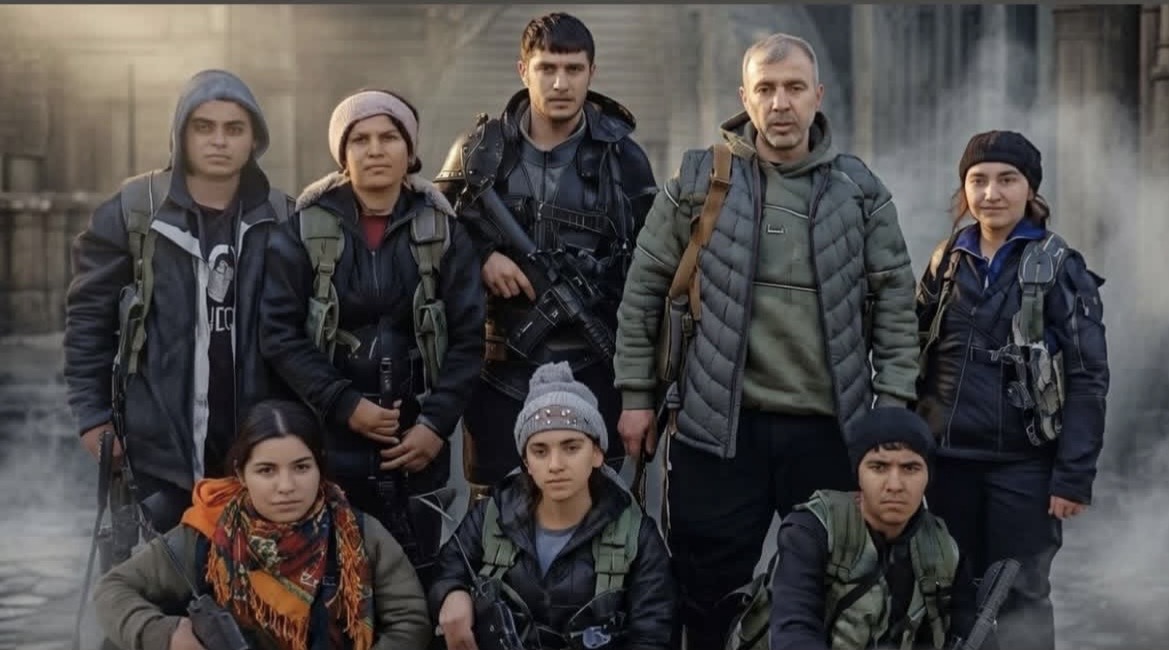
Today, before the eyes of the entire world, the Kurdish people living in the Sheikh Maqsoud and Ashrafiyeh neighborhoods were once again subjected to genocide. These neighborhoods, monuments of resistance, stood firm like fortresses with their 14-year history of resistance, and this spirit of resistance was inscribed in all their streets. When attacked again today, they showed the same determination with this spirit and consciousness. The 21st century’s contemporary Lepzerin, Ziyad Halep, together with the defense forces, transformed two small neighborhoods into Dimdim Castle and defended them with resistance until their last breath1.
The strategy and plans developed by the caste-based killer2 were more multidimensional and deeper this time. Like the 104 Me, the wisdom of knowledge stolen from the goddess in the well-known Enuma Elish epic, the goddess culture attempted to be turned into monster terminology, and the betrayal of the son. Beyond this, in the battle between Tiamat and Marduk that these names symbolize, they represent more than two names—the resisting mother goddess society and the caste-based killer. Those who resisted in Sheikh Maqsoud and Ashrafiyeh were also descendants of Tiamat. They resisted because protection was a characteristic of goddesses. These warriors, heirs to goddess culture, fought with self-sacrifice as continuators of the resistance tradition, and gained the highest rank in society’s memory.
Today, once again, as 3,200 years ago, plunders, theft, rape, deportation policies and mass genocides, are products of the same mentality. Now the caste-based killers cannot deceive societies that have created their own self-defense and organization with the fake historical understanding and narratives they have written; with the perception operations they have created. With the Rojava Revolution, the goddess culture that regained strength and the female identity leading society, have become a force standing against the caste-based killer mentality. Therefore, women are the target of attacks. As the whole world knows, when the lifeless body of a young woman from Halep’s internal security forces was thrown down from the third floor during the clashes in Sheikh Maqsoud, what fell from there was the mask of the jihadist forces representing the caste-based killer. What rose there through resistance, saying “Ya Star” and taking refuge in the roots of their faith, are the sacred values of this society embodied in resistant female warriors.
The fact is that history is not a linear progression but a life cycle maintaining its interconnectedness, woven by women’s hands. While the egocentric dominant mind of the caste-based killer—”I exist, I created, I won”—is relegated to the dusty shelves of history, what we will not forget, and will not let be forgotten, will be the resistance of 300 warriors and the women’s council’s insistence on resistance, which will be told for another 3,000 years. Today, the mask covering the appearance of those who want to hide their caste-based killer identity is falling, and the name of the light reflected through the cracks in the foundation of the capitalist system—the age of maskless gods and naked kings—is the Democratic Society Manifesto. That this continues under women’s leadership, on the lands where goddess culture was born, is certainly not a coincidence, but proof that these veins are still alive on these lands.
1Emir Jan Lepzerin plays an important role in the history of Kurdistan. He became known for his role in the resistance against the Safavid Empire under Shah Abbas I in the early 17th century. It is said that Lepzerin and his allies defended the fortress of Dimdim (kela dimdim) with their lives until the end.
2“Caste-based killers” is a concept coined by Abdullah Öcalan in his Manifesto for Peace and a Democratic Society. He uses it to describe a form of power, a patriarchal structure of domination, and a mindset based on the destruction and annihilation of free and communal society.